from the Journal of Agriculture, Food Systems, and Community Development |
|
|
|
JAFSCD is the world’s only community-supported journal. JAFSCD content is open access (free) thanks to the generous support of our shareholders: the JAFSCD Shareholder Consortium, Library Shareholders, a growing number of Individual Shareholders, and our JAFSCD Partners: |
|
|
In 2023, food insecurity affected 13.5% (18 million) of U.S. households, with rates four times higher among individuals experiencing homelessness or living with disabilities. Food insecurity among older adults also remains above pre–Great Recession levels, reflecting a long-standing vulnerability of this population. The federally funded Supplemental Nutrition Assistance Program (SNAP) plays a critical role in addressing food insecurity by providing individuals and families with low incomes with financial support to purchase groceries. SNAP has broad national reach and importance. In 2023, more than 41 million people were enrolled in SNAP each month on average, and studies have estimated that participation in SNAP reduces food insecurity by up to 30%. Despite SNAP’s general success in mitigating food insecurity, barriers to its use exist for vulnerable populations .
In a new JAFSCD article, SNAP's Restaurant Meals Program: Understanding drivers and constraints on state adoption and implementation, authors from John Hopkins University and Colorado State University sought to understand the impact of the Restaurant Meals Program (RMP), an extension of SNAP, which allows certain SNAP participants to spend benefits on prepared meals at authorized restaurants. RMP holds strong potential to enhance food security among some of the most high-risk SNAP participants. Nevertheless, adoption remains limited, and little empirical research has examined drivers, constraints, and best practices. This study aimed to address critical gaps in SNAP policy research by (a) reviewing existing evidence on RMP implementation and evaluation; and (b) examining the perspectives of state administrators and independent restaurant owners on factors influencing program adoption, restaurant participation, and outcomes for eligible SNAP participants.
Corresponding author Yeeli Mui can be contacted at ymui1@jhu.edu.
KEY FINDINGS Drivers supporting RMP adoption and implementation include: - Championing food access and food security;
- Connecting local restaurants, communities, and cultures; and
- Growing business revenue stimulates local economies.
RECOMMENDATIONS FOR POLICY, PRACTICE, AND RESEARCH - States and restaurants are burdened by onerous administrative processes.
- Dominance of fast-food chains undermines the driver of connecting local restaurants, communities and cultures.
-
Gaps in program evaluation limit the data needed to encourage RMP adoption.
SHARE ON YOUR SOCIALS
An innovative approach to food insecurity is the #SNAP Restaurant Meal Program. To learn more about this approach — and its strengths and limitations at the state and local levels — read the @JAFSCD article for free: https://doi.org/10.5304/jafscd.2026.152.013
#foodsecurity #SNAPbenefits #JohnsHopkinsU #ColoradoStateU |
|
|
|
Photo above: Sheila Hamilton, left, and Judy Honoré give thanks before eating a meal at Café Reconcile in New Orleans, Louisiana, in February 2023. Café Reconcile participates in the SNAP Employment and Training initiative for youth ages 16-24. Café Reconcile combines hands-on food service training with classroom instruction, individual case management, job placement services, and follow-up support to develop a participant’s ability to become independent, self-sufficient, and successfully employed. USDA photo by Christopher Paul via Flickr.
|
|
|
| | INFAS Food Systems Fellowship Application for 2026–2027
The INFAS Food Systems Fellowship (FSF) Program for 2026–2027 welcomes applications from graduate students who aim to engage with communities in their food systems–related field of study. This fellowship program provides professional development and mentoring, generally, and toward engaging with communities in ethical and respectful ways in students’ present or future research and work, specifically. Applications must be received by June 1, 2026. |
|
|
|
EVENT FROM A KINDRED ORGANIZATION |
|
|
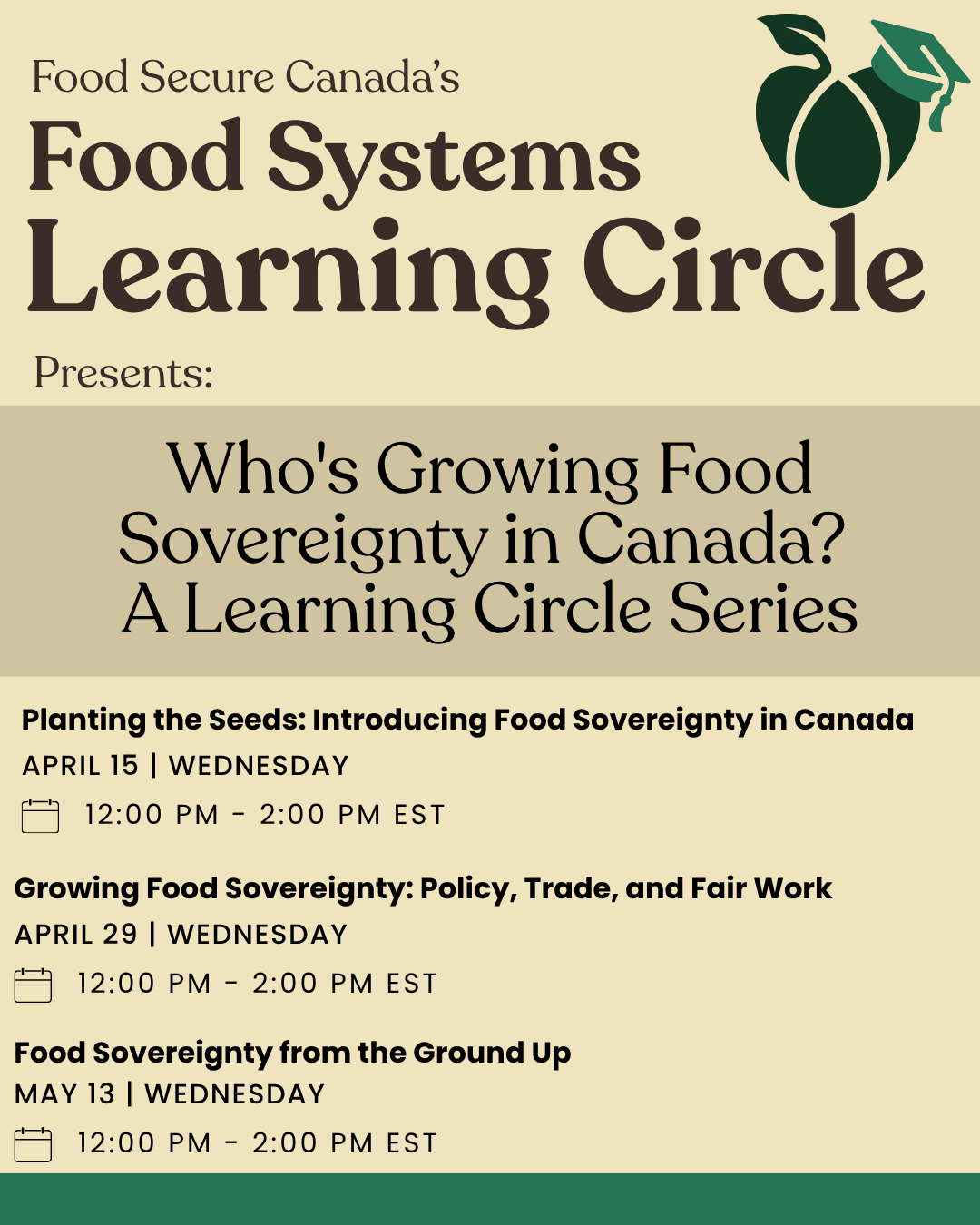
Who's Growing Food Sovereignty in Canada?
Join Food Secure Canada for a new workshop series
Food Secure Canada is launching the Food Systems Learning Circle with a three-part online workshop series: Who's Growing Food Sovereignty in Canada? |
|
|
|
-
Workshop 3 — Food Sovereignty from the Ground Up Wednesday, May 13 | 12:00–2:00 PM ET
Speakers include Raj Patel (U of Texas, Austin), Celeste Smith (National Farmers Union), Chris Ramsaroop (Justicia for Migrant Workers), Toyin Kayo-Ajayi (Canadian Black Farmers Association), Tabitha Robin (UBC), Joseph LeBlanc (NOSM University), Geneviève Lalumière (Union Paysanne), and Cathy Holtslander (National Farmers Union).
Sessions are held online in English with French interpretation. Recordings will be available to all registered participants. Pricing: - Single session: $60 standard | $30 student/unwaged | $15 solidarity
- Full series: $150 standard | $70 student/unwaged | $40 solidarity
No one will be turned away for lack of funds. If cost is a barrier, please reach out before registering.
Register here |
|
|
|
This email is sent to you as a notification of the newest JAFSCD articles and other occasional JAFSCD news. |
|
|
JAFSCD is an open access, community-supported journal! Your library, program, or organization can become a shareholder to help keep JAFSCD's content available to all, regardless of their resources. We welcome anyone to become an individual shareholder; donations are tax-deductible to the extent allowed by law.
|
|
|
|
|