from the Journal of Agriculture, Food Systems, and Community Development |
|
|
JAFSCD is the world’s only community-supported journal. JAFSCD content is open access (free) thanks to the generous support of our shareholders: the JAFSCD Shareholder Consortium, Library Shareholders, a growing number of Individual Shareholders, and our JAFSCD Partners: |
|
|
JAFSCD peer-reviewed article by Maria DeNunzio (Virginia Tech), Bailey Houghtaling (Center for Nutrition & Health Impact), Victor Olayemi (Virginia Tech), Elena Serrano (Virginia Tech), Maaz Gardezi (Virginia Tech), Vivica Kraak (Virginia Tech), Sam Hedges (Virginia Fresh Match), and Sarah Misyak (Virginia Tech) Independent food retail owners and managers were interested in planetary health promotion practices for their business — but there were significant barriers in cost and alignment with customer expectations.
Healthy food retail initiatives are often used to promote nutrition security in U.S. Despite the close connections between planetary health and nutrition security, planetary health promotion has been under-emphasized in healthy food retail. A first step toward expanded programming for concurrent nutrition security and planetary health promotion is to understand how key agents of change—independent food retail owners and managers—perceive their role in planetary health promotion.
In a new JAFSCD article, Virginia independent food retailer perceptions of their role in planetary health promotion, authors Maria DeNunzio, Bailey Houghtaling, Victor Olayemi, Elena Serrano, Maaz Gardezi, Vivica Kraak, Sam Hedges, and Sarah Misyak present findings from a study that aimed to understand how food retailers perceived their role in planetary health promotion and barriers and facilitators to implementing planetary health promotion practices in stores using an implementation science lens.
Corresponding author Dr. Sarah Misyak can be contacted at smisyak@vt.edu. KEY FINDINGS
Food retailer amenability to planetary health practices depended on alignment of the practice with profit potential and customer expectations. Preferred practices varied by store format and community context, including the range of customer expectations across contexts.
Different types of food retailers were interested in different types of practices: cooperatives included planetary health in all business decisions; farm stores focused primarily on agricultural practices; and grocers were most interested in practices that aligned with profit potential and customer expectations.
Potential planetary health promotion practices identified by retailers were agricultural practices of suppliers, offering items in bulk, decreasing energy usage, decreasing food miles, increasing local foods, animal source protein reduction, and waste reduction.
RECOMMENDATIONS FOR POLICY, PRACTICE, AND RESEARCH The results align with and extend known considerations for healthy food retail research and practice into the previously unexplored topic of planetary health promotion in U.S. independent food retail settings. Implications of these results are that healthy food retail researchers and practitioners can leverage known best practices and infrastructure to work on designing expanded programming that includes planetary health promotion. SHARE ON YOUR SOCIALS
Are independent food retailers interested in planetary health promotion practices in their stores? The answer is yes — as long as the practices do not interfere with profit potential and there is technical assistance available for implementation. Interviews with twelve independent food retail owners and managers in Virginia provided insight into the potential for food stores to take action to support planetary health, and what these business owners would need in order to do so. Read the full @JAFSCD article for free: https://doi.org/10.5304/jafscd.2026.152.025
|
|
|
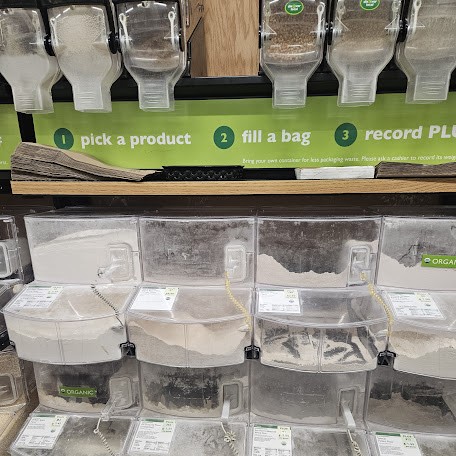
Image above: The Roanoke Co+op in Roanoke, Virginia, USA, offers self-service bins for customers to measure their preferred quantity of a variety of foods. Photo provided by the authors. |
|
|
Cover photo credit: © Littleny, ID 26656408 | Dreamstime.com |
|
The spring 2026 issue shares 20 open call papers on a wide range of food systems topics, many aimed at righting systemic food and farming inequalities — to quote the editorial from editor-in-chief Duncan Hilchey. They’re joined by 2 columns, a viewpoint, a commentary, and 15 book reviews!
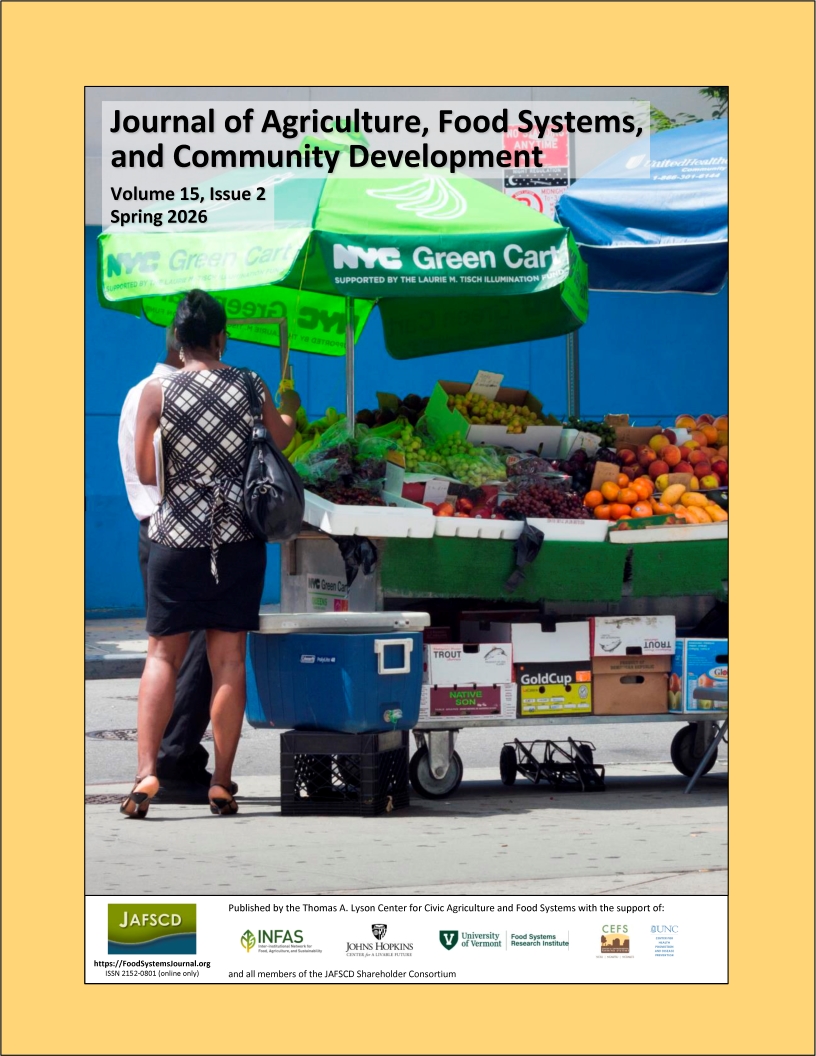
On our cover, a NYC Green Cart on a street in Jamaica, Queens, New York, is one of many that sell fresh fruits and vegetables to promote healthy eating in neighborhoods that lack access. See the article Sustaining mobile produce vending in NYC: Evaluating the future of Green Carts, for an analysis of the successes and challenges of the NYC Green Carts program.
|
|
|
You can read or download any of the articles or the entire issue for free, as always. |
|
|
EVENT FROM A KINDRED ORGANIZATION |
|
|
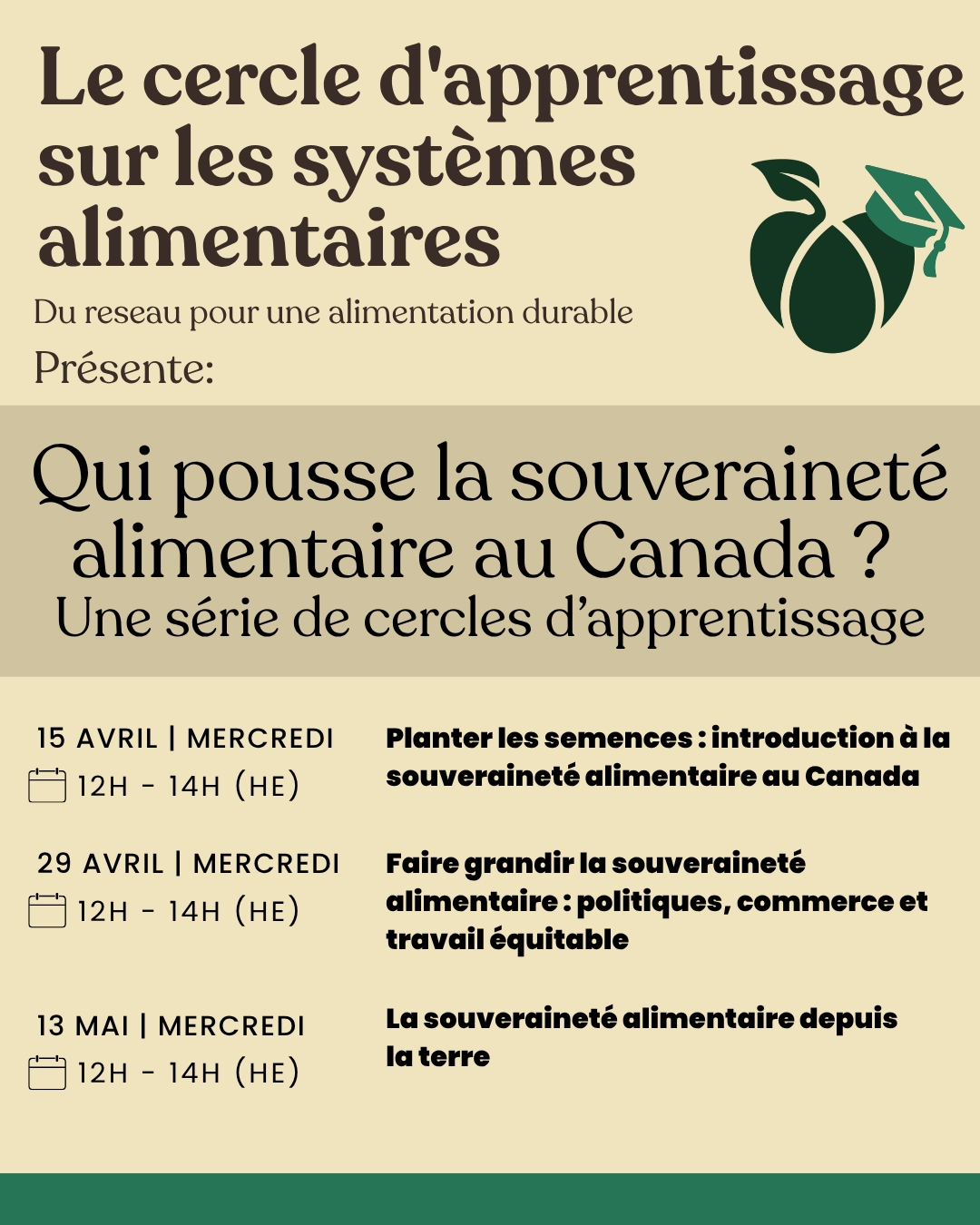
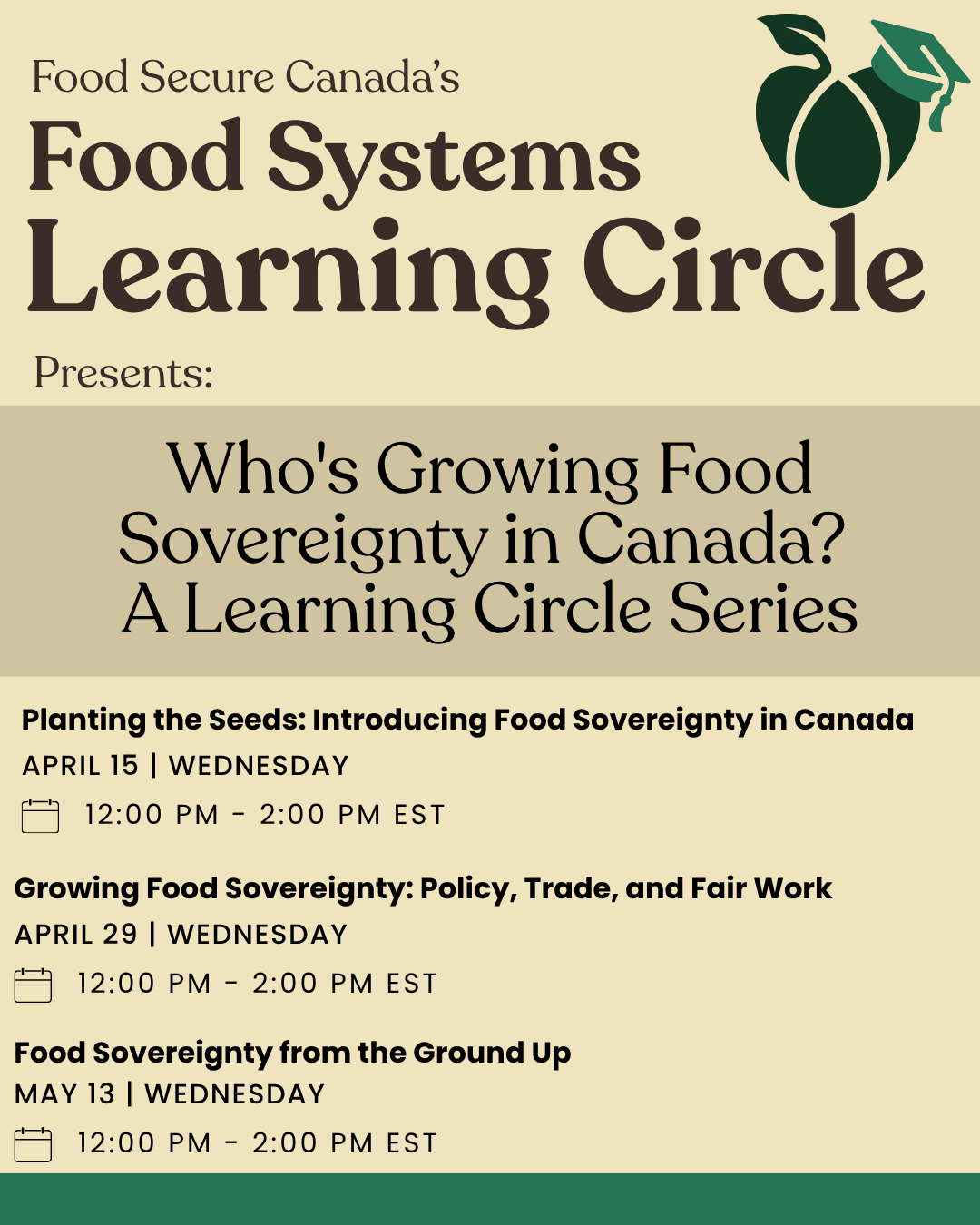
Who's Growing Food Sovereignty in Canada?
Join Food Secure Canada for a new workshop series
Food Secure Canada is launching the Food Systems Learning Circle with a three-part online workshop series: Who's Growing Food Sovereignty in Canada? |
|
|
- Workshop 2 — Growing Food Sovereignty: Policy, Trade, and Fair Work Wednesday, April 29 | 12:00–2:00 PM ET
-
Workshop 3 — Food Sovereignty from the Ground Up Wednesday, May 13 | 12:00–2:00 PM ET
Speakers include Raj Patel (U of Texas, Austin), Celeste Smith (National Farmers Union), Chris Ramsaroop (Justicia for Migrant Workers), Toyin Kayo-Ajayi (Canadian Black Farmers Association), Tabitha Robin (UBC), Joseph LeBlanc (NOSM University), Geneviève Lalumière (Union Paysanne), and Cathy Holtslander (National Farmers Union).
Sessions are held online in English with French interpretation. Recordings will be available to all registered participants. Pricing: - Single session: $60 standard | $30 student/unwaged | $15 solidarity
- Full series: $150 standard | $70 student/unwaged | $40 solidarity
No one will be turned away for lack of funds. If cost is a barrier, please reach out before registering.
Register here |
|
|
This email is sent to you as a notification of the newest JAFSCD articles and other occasional JAFSCD news. |
|
JAFSCD is an open access, community-supported journal! Your library, program, or organization can become a shareholder to help keep JAFSCD's content available to all, regardless of their resources. We welcome anyone to become an individual shareholder; donations are tax-deductible to the extent allowed by law.
|
|
| |