from the Journal of Agriculture, Food Systems, and Community Development |
|
|
JAFSCD is the world’s only community-supported journal. JAFSCD content is open access (free) thanks to the generous support of our shareholders: the JAFSCD Shareholder Consortium, Library Shareholders, a growing number of Individual Shareholders, and our JAFSCD Partners: |
|
|
JAFSCD peer-reviewed article by Aline Issa (Notre Dame U–Louaize), Samar Merhi (Notre Dame U–Louaize), Jessy El Hayek Fares (Notre Dame U–Louaize), Elie Bou Yazbeck (Holy Spirit U of Kaslik), and Marc Bou Zeidan (Notre Dame U–Louaize & QOOT Lebanese Agrifood Cluster)
How do small food businesses survive when war, economic collapse, and inflation collide? A new study examines how Lebanon’s agri-food SMEs are navigating one of the most severe compounded crisis environments in modern history.
Lebanon’s food system has endured overlapping shocks since 2019, including economic collapse, currency devaluation, COVID-19, the Beirut Port explosion, and renewed armed conflict. These crises have placed enormous pressure on agri-food small and medium enterprises (SMEs), which form the backbone of Lebanon’s food industry and represent approximately 95% of businesses nationwide.
In a new article, Impact of conflict on Lebanon’s food industry: Challenges, needs, and emergency preparedness, Issa et al. present findings from a quantitative survey of 62 agri-food SMEs in the QOOT Lebanese Agrifood Cluster. The study evaluates the operational impact of war across financial performance, supply chains, human resources, infrastructure, and market access, and identifies urgent recovery priorities.
Corresponding author Dr. Samar Merhi can be contacted at smerhi@ndu.edu.lb.
KEY FINDINGS 98.4% of surveyed SMEs reported being affected by the war. 90.3% experienced monetary losses, most commonly between US$10,000 and US$50,000.
Financial constraints (91.9%) and reduced access to markets (91.9%) were the most reported challenges. 74% experienced supply chain and procurement disruptions, including import route interruptions and raw material shortages. Over half reported workforce-related concerns, including employee safety and disrupted access to workplaces.
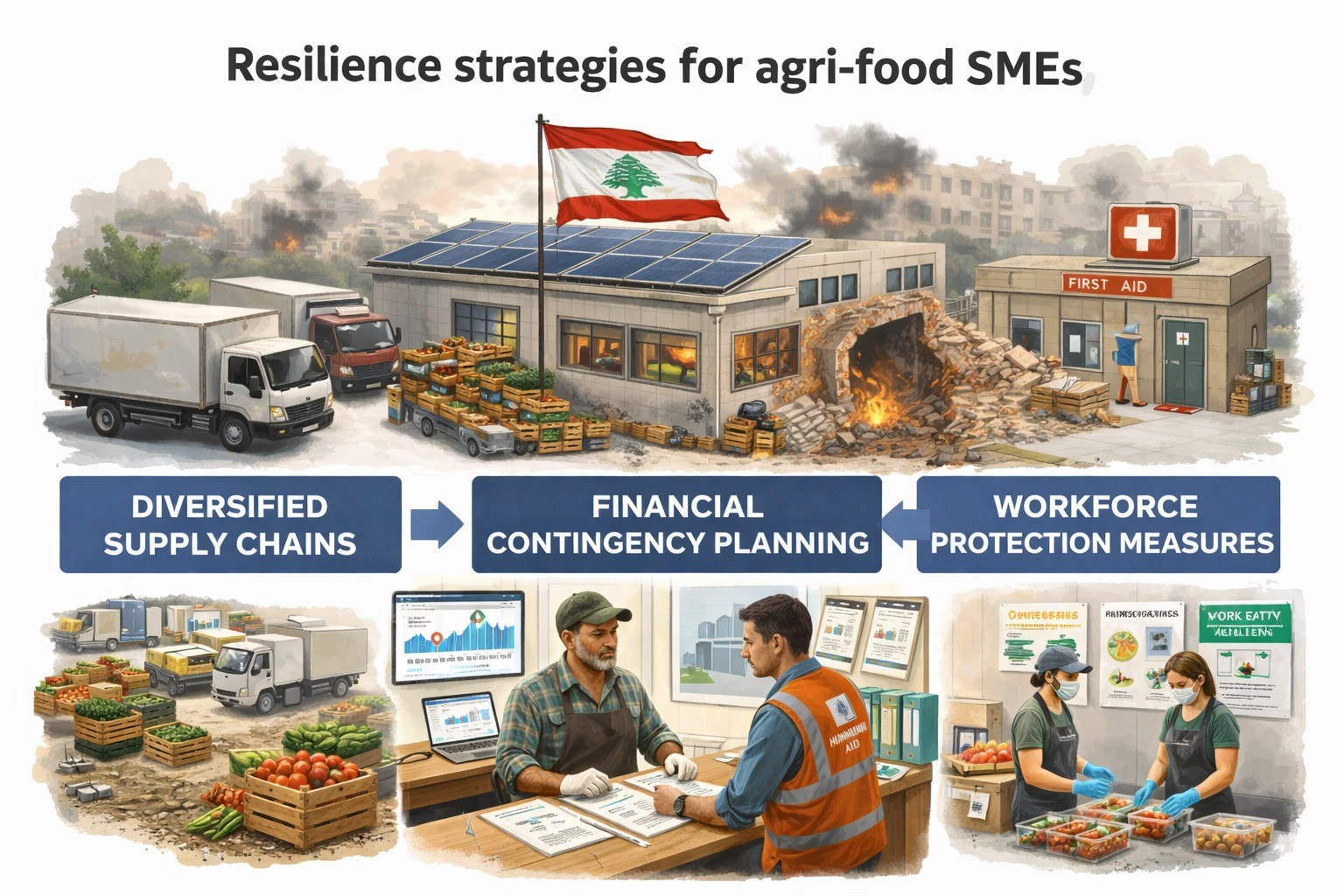
The most urgent needs identified were emergency financial assistance, alternative market channels, supply chain diversification, workforce protection measures, and infrastructure support.
The findings demonstrate how conflict amplifies pre-existing economic fragility and exposes systemic vulnerabilities in food systems. RECOMMENDATIONS FOR POLICY, PRACTICE, AND RESEARCH Establish emergency funds and accessible credit mechanisms for SMEs in crisis settings.
Diversify market channels, including e-commerce and local distribution partnerships. Strengthen local supply chains and secure alternative raw material sources.
Develop workforce safety nets and crisis contingency staffing plans. Recognize the food industry as a critical sector requiring protection during emergencies.
Integrate humanitarian, development, and peace building strategies to safeguard food system resilience.
The authors emphasize that protecting agri-food SMEs is not only an economic priority but a food security imperative. SHARE ON YOUR SOCIALS
How does war affect the businesses that put food on our tables? A new study published in JAFSCD examines how Lebanon’s agri-food small and medium enterprises (SMEs) are surviving amid conflict, economic collapse, and inflation—and what they urgently need to stay operational. Read the full @JAFSCD article for free: https://doi.org/10.5304/jafscd.2026.152.017
#Lebanon #conflict #agrifood #enterprises #SMEs |
|
|
Image above: A conceptual illustration of resilience strategies for agri-food small and medium enterprises (SMEs) in Lebanon during crisis. |
|
|
EVENT FROM A KINDRED ORGANIZATION |
|
|
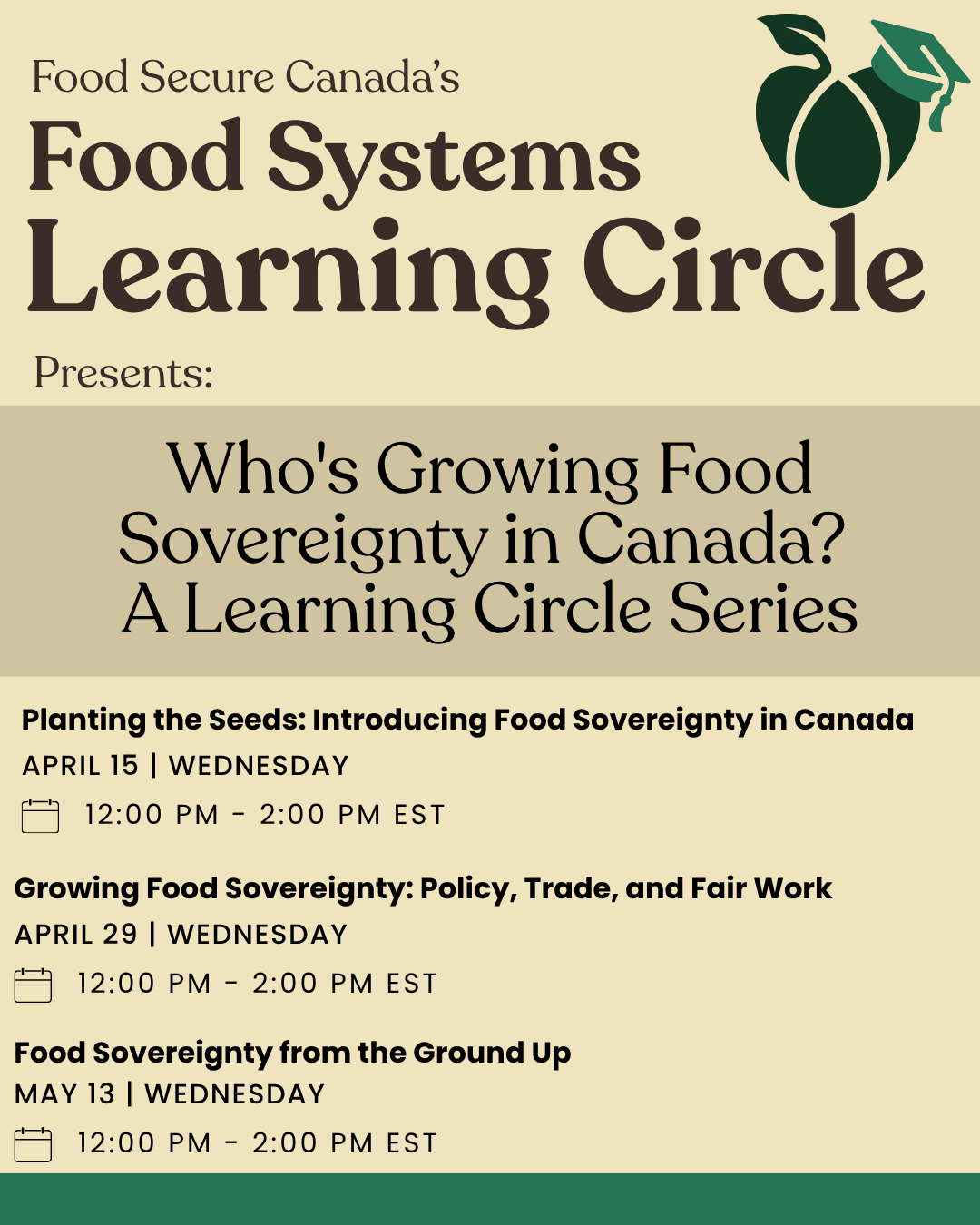
Who's Growing Food Sovereignty in Canada?
Join Food Secure Canada for a new workshop series
Food Secure Canada is launching the Food Systems Learning Circle with a three-part online workshop series: Who's Growing Food Sovereignty in Canada? |
|
|
- Workshop 2 — Growing Food Sovereignty: Policy, Trade, and Fair Work Wednesday, April 29 | 12:00–2:00 PM ET
-
Workshop 3 — Food Sovereignty from the Ground Up Wednesday, May 13 | 12:00–2:00 PM ET
Speakers include Raj Patel (U of Texas, Austin), Celeste Smith (National Farmers Union), Chris Ramsaroop (Justicia for Migrant Workers), Toyin Kayo-Ajayi (Canadian Black Farmers Association), Tabitha Robin (UBC), Joseph LeBlanc (NOSM University), Geneviève Lalumière (Union Paysanne), and Cathy Holtslander (National Farmers Union).
Sessions are held online in English with French interpretation. Recordings will be available to all registered participants. Pricing: - Single session: $60 standard | $30 student/unwaged | $15 solidarity
- Full series: $150 standard | $70 student/unwaged | $40 solidarity
No one will be turned away for lack of funds. If cost is a barrier, please reach out before registering.
Register here |
|
|
JAFSCD SHAREHOLDER'S EVENT |
|
|
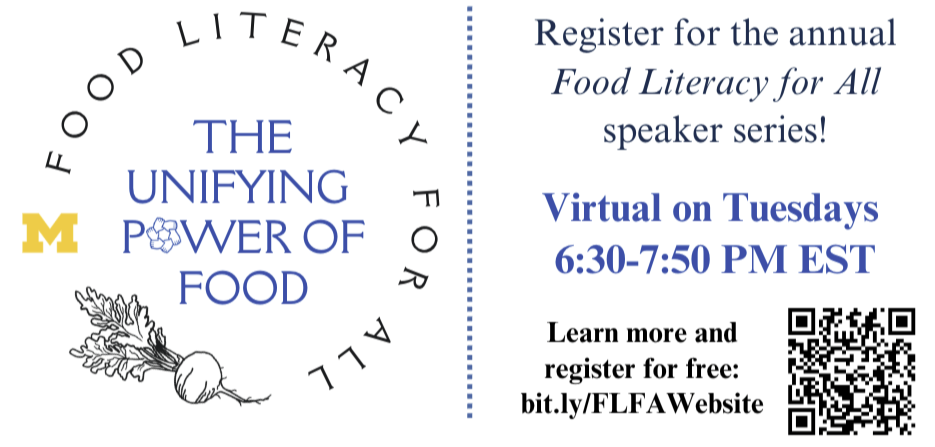
Food Literacy for All is a community-academic partnership course at the University of Michigan, now in its 10th year.
From January to April, Food Literacy for All features a dynamic session each Tuesday evening (6:30-7:50 pm ET) that addresses the challenges and opportunities of diverse food systems. All sessions are on Zoom and recordings are shared afterward.
Upcoming session: - April 21: Course Reflection
See the schedule and register for free as a community member on the website. Registration is rolling, so you can sign up anytime and attend the sessions that interest you. Register once and received reminders of each week's webinar.
|
|
|
This email is sent to you as a notification of the newest JAFSCD articles and other occasional JAFSCD news. |
|
JAFSCD is an open access, community-supported journal! Your library, program, or organization can become a shareholder to help keep JAFSCD's content available to all, regardless of their resources. We welcome anyone to become an individual shareholder; donations are tax-deductible to the extent allowed by law.
|
|
|
|