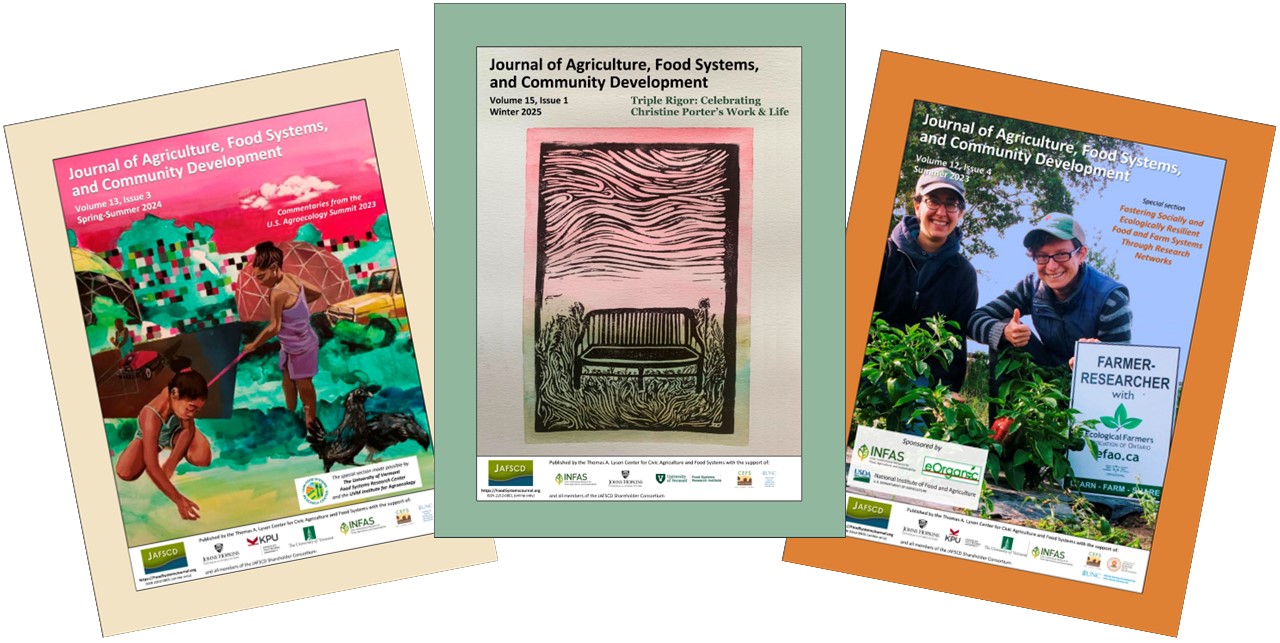
from the Journal of Agriculture, Food Systems, and Community Development |
|
|
JAFSCD is the world’s only community-supported journal. JAFSCD content is open access (free) thanks to the generous support of our shareholders: the JAFSCD Shareholder Consortium, Library Shareholders, a growing number of Individual Shareholders, and our JAFSCD Partners: |
|
|
To build a truly resilient food system in the face of climate change, communities must reconcile the technocratic, efficiency-driven logic of food security with the relational, self-determined ethics of food sovereignty by bridging the fundamental divide between Western Science and Indigenous Knowledge.
Farmers play a critical role in food systems, rural economies, ecological sustainability, and the social fabric of communities. As farmers age, new farmers are needed to maintain the stability of the agricultural sector. Without skilled individuals willing and able to take up farming as a career, the future of domestic food production is in jeopardy. This has a range of environmental, social, and economic implications.
In a new JAFSCD article, Bridging Western and Indigenous epistemologies in an opaque world: Food security and food sovereignty as climate adaptation, authors Garin Bulger, Dr. Will Butler, Dr. Tisha Holmes, and Dr. Karen Lowrie analyze how community organizations in Alaska and Puerto Rico navigate the ontological divide between Western Science and Indigenous Knowledge to bridge the gap between technocratic food security and relational food sovereignty as a strategy for climate adaptation.
Corresponding author Garin Bulger can be contacted at garin.bulger@rutgers.edu.
KEY FINDINGS
In the case studies, community members do not treat food security and food sovereignty as a strict binary; instead, they selectively weave these frameworks together to meet specific ecological and cultural needs, such as integrating hydroponic infrastructure with traditional subsistence ethics.
Agroecological methods that combine ancestral practices with ecological science have proven more resilient to extreme climate events than conventional industrialized monoculture, as evidenced by farms in Puerto Rico sustaining minimal damage during hurricanes Irma and Maria.
Navigating tensions between Western Science and Indigenous Knowledge is most effective when grounded in long-term interpersonal relationships and trust-building, which allow partners to collaborate through the discomfort of conflicting worldviews.
RECOMMENDATIONS FOR POLICY, PRACTICE, AND RESEARCH Prioritize Relational Funding: Grantmakers should move beyond technocratic reporting and prioritize long-term funding for relationship-building and community engagement, recognizing that trust is the primary vehicle for knowledge co-production. Implement "Two-Eyed Seeing" Models: Organizations working in climate adaptation should adopt frameworks such as Two-Eyed Seeing or the Six Rs to ensure that Western scientific tools serve as partners to Indigenous sovereignty rather than replacements for local knowledge. Support Land Tenure and Sovereignty: Policy efforts must address structural barriers, specifically land access, that impede communities' ability to practice the agroecological methods proven to be more resilient to climate shocks.
SHARE ON YOUR SOCIALS
A recent article from JAFSCD states "to build a truly #resilient food system in the face of climate change, communities must reconcile the technocratic, efficiency-driven logic of food security with the relational, self-determined ethics of #foodsovereignty by bridging the fundamental divide between Western Science and #Indigenous Knowledge." Learn more about the twin sciences and read the article for free @JAFSCD: https://doi.org/10.5304/jafscd.2026.152.036
|
|
|
Image above: Stacked gourds at a farm stand near Ithaca, New York, USA. Photo © 2019 by Amy Christian. |
|
|
ANNOUNCEMENT FROM JAFSCD PARTNER UVM |
|
|
The University of Vermont launches fully online Master of Science in Agroecology
Designed for professionals already working in food systems who want to deepen their practice without leaving their communities, the program was created by the UVM Department of Agriculture, Landscape & Environment and the UVM Institute for Agroecology, shaped by conversations with farmers, organizers, policymakers, and students who emphasized that transforming food systems requires new ways of learning and collaborating.
Applications for the first cohort are due July 15, 2026.
Find out more by attending an upcoming webinar:
Agroecology at UVM: Cultivating a Thriving Planet through Knowledge and Action
>> Thursday, April 9 | 4:00 PM to 5:30 PM EDT | Virtual or in-person
Read a story about the program — First-of-its kind Master's in Agroecology at UVM — and get more info at LinkedIn, Instagram, and Facebook.
|
|
|
EVENT FROM A KINDRED ORGANIZATION |
|
|
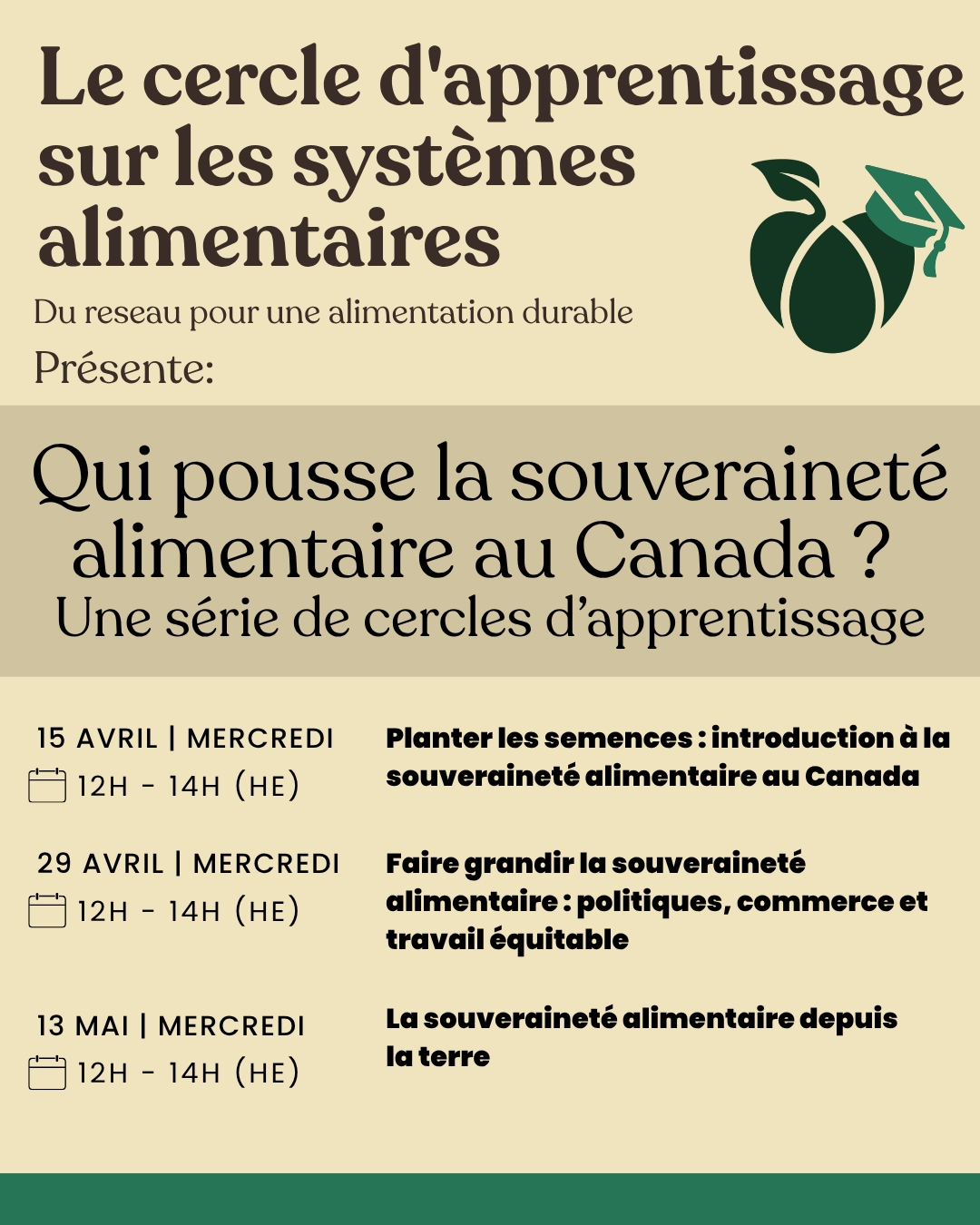
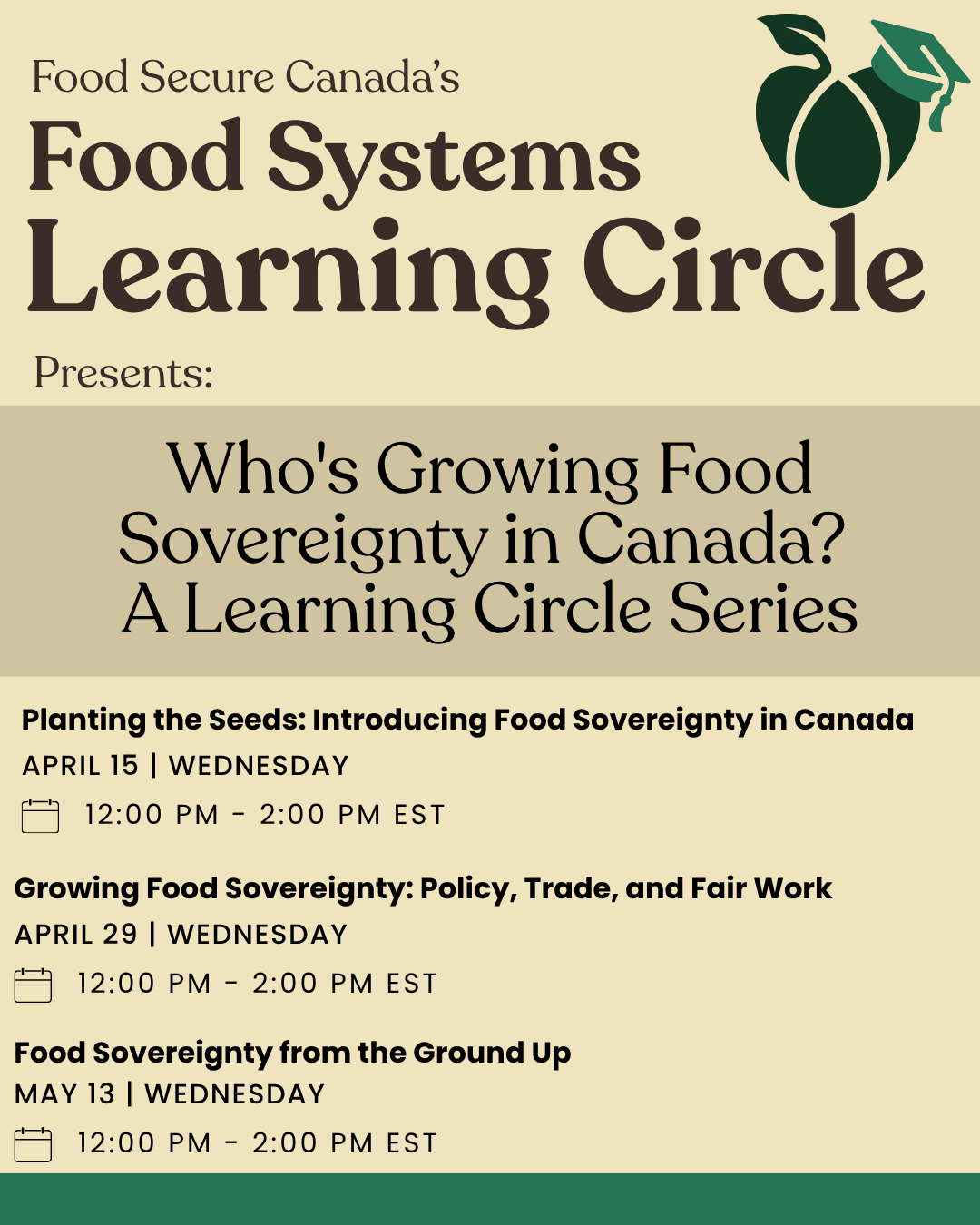
Who's Growing Food Sovereignty in Canada?
Join Food Secure Canada for a new workshop series
Food Secure Canada is launching the Food Systems Learning Circle with a three-part online workshop series: Who's Growing Food Sovereignty in Canada? |
|
|
Workshop 1 — Planting the Seeds: Introducing Food Sovereignty in Canada Wednesday, April 15 | 12:00–2:00 PM ET
Workshop 2 — Growing Food Sovereignty: Policy, Trade, and Fair Work Wednesday, April 29 | 12:00–2:00 PM ET - Workshop 3 — Food Sovereignty from the Ground Up Wednesday, May 13 | 12:00–2:00 PM ET
Speakers include Raj Patel (U of Texas, Austin), Celeste Smith (National Farmers Union), Chris Ramsaroop (Justicia for Migrant Workers), Toyin Kayo-Ajayi (Canadian Black Farmers Association), Tabitha Robin (UBC), Joseph LeBlanc (NOSM University), Geneviève Lalumière (Union Paysanne), and Cathy Holtslander (National Farmers Union).
Sessions are held online in English with French interpretation. Recordings will be available to all registered participants. Pricing: - Single session: $60 standard | $30 student/unwaged | $15 solidarity
- Full series: $150 standard | $70 student/unwaged | $40 solidarity
No one will be turned away for lack of funds. If cost is a barrier, please reach out before registering.
Register here |
|
|
JAFSCD SHAREHOLDER'S EVENT |
|
|
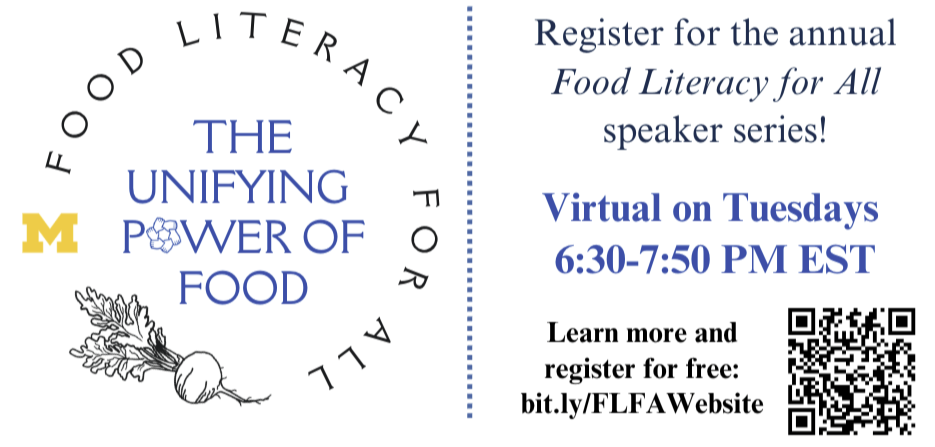
Food Literacy for All is a community-academic partnership course at the University of Michigan, now in its 10th year.
From January to April, Food Literacy for All features a dynamic session each Tuesday evening (6:30-7:50 pm ET) that addresses the challenges and opportunities of diverse food systems. All sessions are on Zoom and recordings are shared afterward.
Upcoming sessions: - April 14: Fast Food for Thought with Ten UM Faculty 5-minute Flash Talks (hybrid event)
-
April 21: Course Reflection
See the schedule and register for free as a community member on the website. Registration is rolling, so you can sign up anytime and attend the sessions that interest you. Register once and received reminders of each week's webinar.
|
|
|
|
Following up on the 7th JAFSCD Community Annual General Meeting on March 18, notes and links to the recording and slide deck are here. We welcome you to catch up on JAFSCD's activities and community news!
|
|
|
This email is sent to you as a notification of the newest JAFSCD articles and other occasional JAFSCD news. |
|
JAFSCD is an open access, community-supported journal! Your library, program, or organization can become a shareholder to help keep JAFSCD's content available to all, regardless of their resources. We welcome anyone to become an individual shareholder; donations are tax-deductible to the extent allowed by law.
|
|
|
|