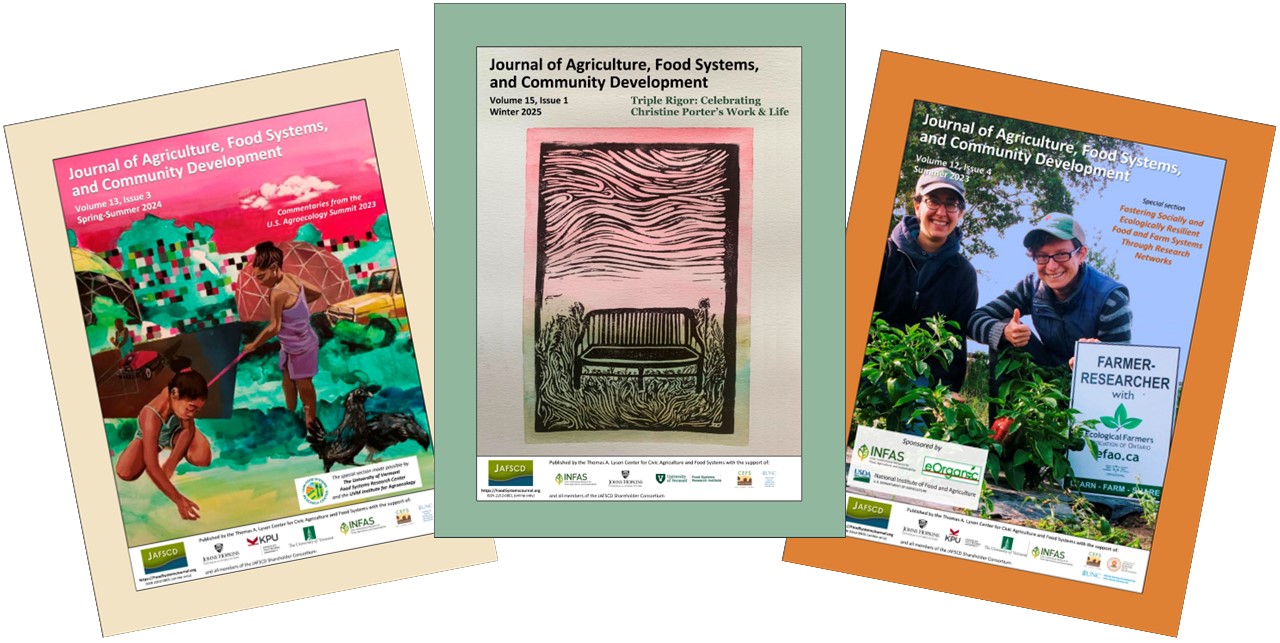
from the Journal of Agriculture, Food Systems, and Community Development |
|
|
JAFSCD is the world’s only community-supported journal. JAFSCD content is open access (free) thanks to the generous support of our shareholders: the JAFSCD Shareholder Consortium, Library Shareholders, a growing number of Individual Shareholders, and our JAFSCD Partners: |
|
|
Farmers in one of Kansas’s fastest-growing counties face rising land prices, development pressure, political restructuring, and increasing competition that threaten the viability of production agriculture. Pottawatomie County, Kansas, combines Flint Hills prairie, commodity crop production, and livestock agriculture with the fastest population growth in the state. While many residents have experienced improved economic well-being, a new JAFSCD article reveals that primary-occupation farmers are experiencing mounting challenges that undermine their livelihoods and social cohesion.
In the article, Challenges to production agriculture in Pottawatomie County, Kansas, USA, Jacob A. Miller-Klugesherz conducted and analyzed 22 in-depth interviews with farmers, agricultural professionals, and community leaders to examine how rapid exurban and suburban development is reshaping relationships between agricultural and non-agricultural stakeholders.
Using Flora et al.’s (2016) community capitals framework integrated with the eco-social symbiosis spectrum, the study shows how social capital—trust, shared values, and networks—has eroded for many primary-occupation farmers, even as development stakeholders and secondary-occupation farmers perceived growth more favorably. Primary-occupation farmers overwhelmingly viewed their relationships with developers as parasitic, citing their inability to compete with residential and commercial land prices. These pressures have also intensified competition among farmers themselves, weakening peer networks that historically supported cooperation, knowledge-sharing, and mutual aid. Conversely, secondary-occupation farmers and community leaders more often expressed commensal or mutualistic relationships, seeing development as an opportunity rather than an existential threat.
The study also highlighted how county commission redistricting and board expansion in 2024 reduced farmers’ political representation, further contributing to feelings of disenfranchisement among those who depend on large, contiguous farmland to remain financially viable.
Jacob can be contacted at jacob.millerklugesherz@kwu.edu.
KEY FINDINGS
Pottawatomie County recorded the fastest population growth in Kansas in 2023, intensifying competition between farmers and developers for land. Primary-occupation farmers perceived relationships with development interests as parasitic, citing land fragmentation, unaffordable land prices, and reduced access to contiguous acreage. Concentrated farm sales accelerated: by 2022, just 6.6% of farms captured over 75% of total agricultural sales in the county. Competitive land-access dynamics emerged among farmers, undermining trust and cooperation.
Secondary-occupation farmers and community leaders more often described mutualistic or commensal relationships with development. County commission redistricting reduced farming stakeholders’ political representation.
RECOMMENDATIONS FOR POLICY, PRACTICE, AND RESEARCH Reform property tax structures to reduce the extent to which farmland owners subsidize exurban and suburban expansion.
Protect contiguous farmland through zoning and land-use tools that balance growth with agricultural viability. Strengthen community-based learning networks that rebuild trust and cooperation among farmers. Encourage alternative land ownership and cooperative models that improve land access for smaller-scale producers.
Invest in local specialty crop infrastructure such as aggregation, storage, and processing facilities.
SHARE ON YOUR SOCIALS
How does rapid growth reshape farming communities? A new study published in JAFSCD by Jacob Miller-Klugesherz examines how population growth, development pressure, and political restructuring in Pottawatomie County, Kansas, are affecting farm viability, social capital, and farmer-to-farmer relationships.
Read the full @JAFSCD article for free: https://doi.org/10.5304/jafscd.2026.152.027
|
|
|
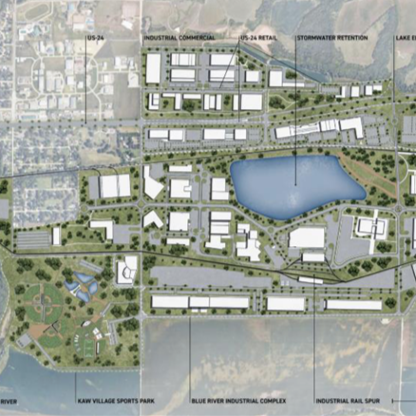
Image above: Image 1 from the article: East Manhattan, Kansas, Gateway Plan Area. Image source: City of Manhattan, Kansas, 2025 |
|
| From the book review:
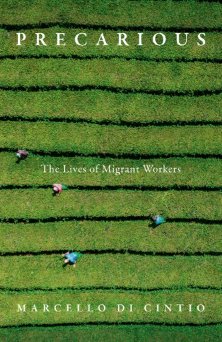
In Precarious: The Lives of Migrant Workers, Marcello Di Cintio offers a deeply researched and powerfully narrated account of the structural vulnerabilities faced by migrant workers in Canada. Through a combination of investigative journalism, historical analysis, and intimate biographical portraits, Di Cintio challenges dominant narratives of Canadian benevolence and exposes the systemic conditions that render thousands of workers “permanently temporary.” At a time when labor shortages and food insecurity dominate public debate, this book provides a timely and necessary examination of the human cost underlying Canada’s economy...The book’s emotional strength lies in its bio-graphical portraits. Di Cintio presents stories of workers from diverse national contexts, situating their individual experiences within broader political and economic histories.
Read the entire book review for free at JAFSCD! |
|
|
EVENT FROM A KINDRED ORGANIZATION |
|
|
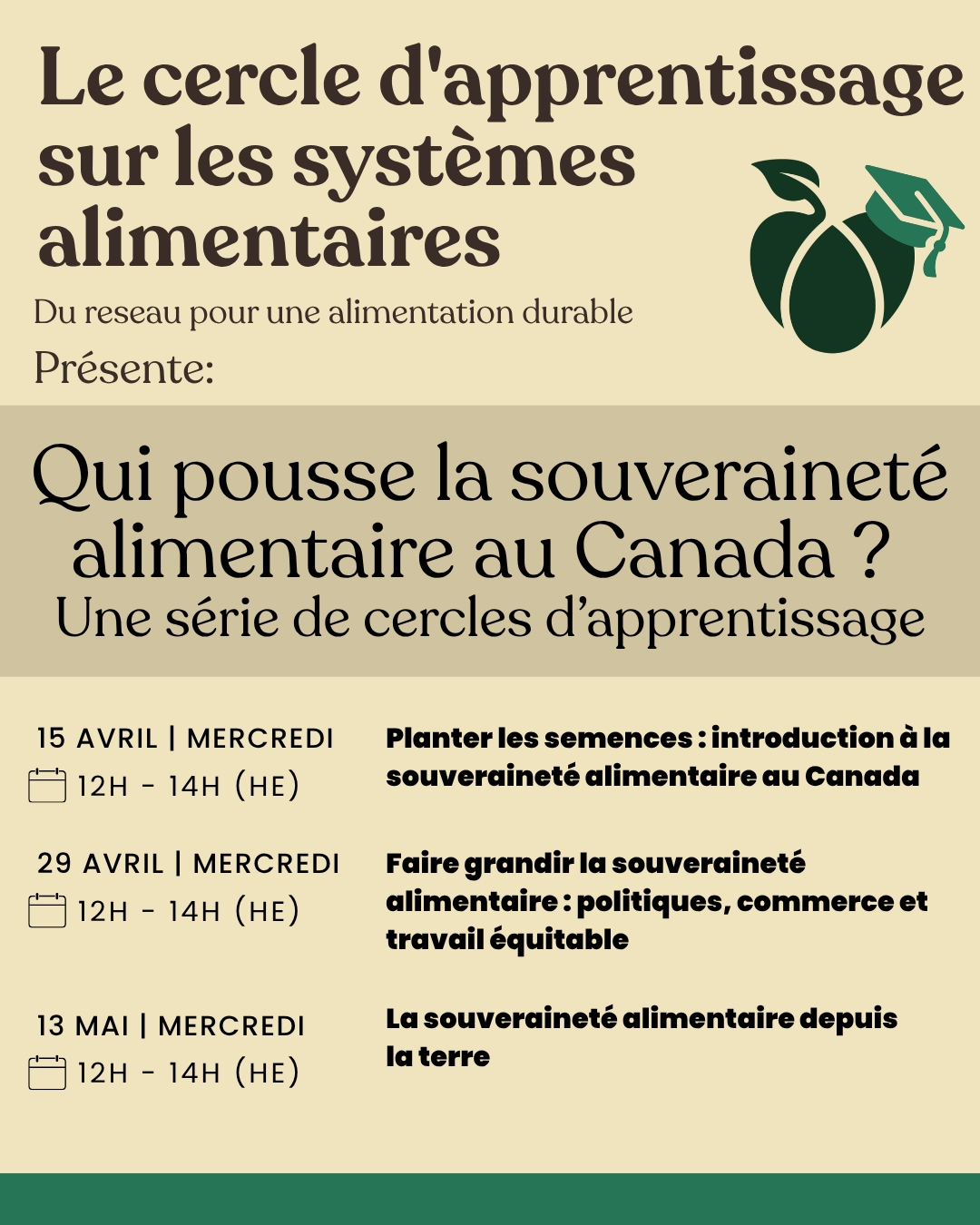
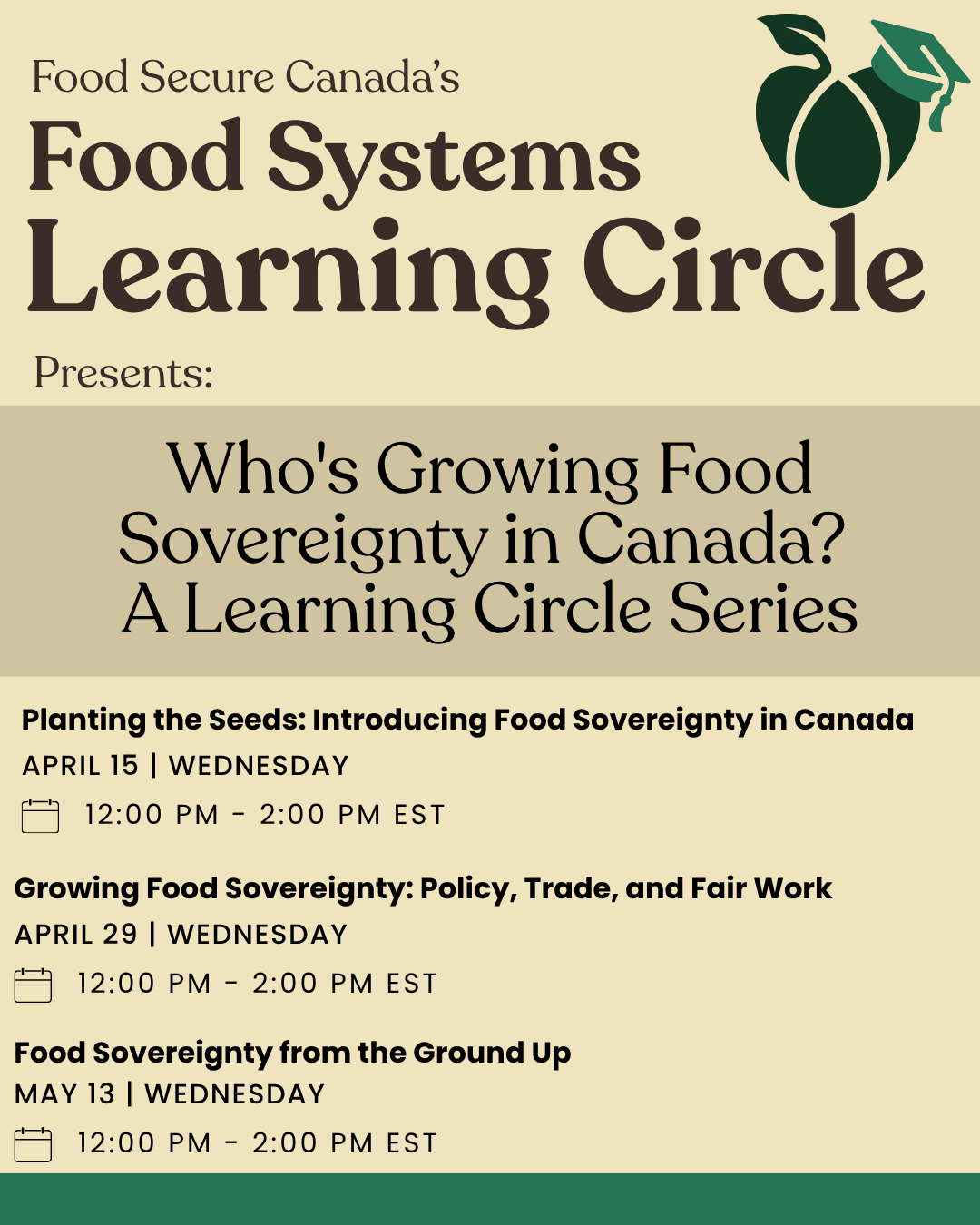
Who's Growing Food Sovereignty in Canada?
Join Food Secure Canada for a new workshop series
Food Secure Canada is launching the Food Systems Learning Circle with a three-part online workshop series: Who's Growing Food Sovereignty in Canada? |
|
|
Workshop 1 — Planting the Seeds: Introducing Food Sovereignty in Canada Wednesday, April 15 | 12:00–2:00 PM ET
Workshop 2 — Growing Food Sovereignty: Policy, Trade, and Fair Work Wednesday, April 29 | 12:00–2:00 PM ET - Workshop 3 — Food Sovereignty from the Ground Up Wednesday, May 13 | 12:00–2:00 PM ET
Speakers include Raj Patel (U of Texas, Austin), Celeste Smith (National Farmers Union), Chris Ramsaroop (Justicia for Migrant Workers), Toyin Kayo-Ajayi (Canadian Black Farmers Association), Tabitha Robin (UBC), Joseph LeBlanc (NOSM University), Geneviève Lalumière (Union Paysanne), and Cathy Holtslander (National Farmers Union).
Sessions are held online in English with French interpretation. Recordings will be available to all registered participants. Pricing: - Single session: $60 standard | $30 student/unwaged | $15 solidarity
- Full series: $150 standard | $70 student/unwaged | $40 solidarity
No one will be turned away for lack of funds. If cost is a barrier, please reach out before registering.
Register here |
|
|
ANNOUNCEMENT FROM JAFSCD PARTNER UVM |
|
|
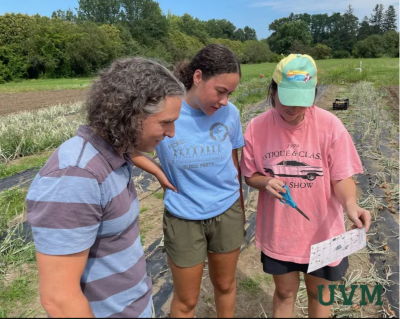
The University of Vermont launches fully online
Master of Science in Agroecology
Designed for professionals already working in food systems who want to deepen their practice without leaving their communities, the program was created by the UVM Department of Agriculture, Landscape & Environment and the UVM Institute for Agroecology, shaped by conversations with farmers, organizers, policymakers, and students who emphasized that transforming food systems requires new ways of learning and collaborating.
Applications for the first cohort are due July 15, 2026.
Find out more by attending an upcoming webinar:
Agroecology at UVM: Cultivating a Thriving Planet through Knowledge and Action
Thursday, April 9 | 4:00 PM to 5:30 PM EDT | Virtual or in-person
Read a story about the program — First-of-its kind Master's in Agroecology at UVM — and get more info at LinkedIn, Instagram, and Facebook.
|
|
|
JAFSCD SHAREHOLDER'S EVENT |
|
|
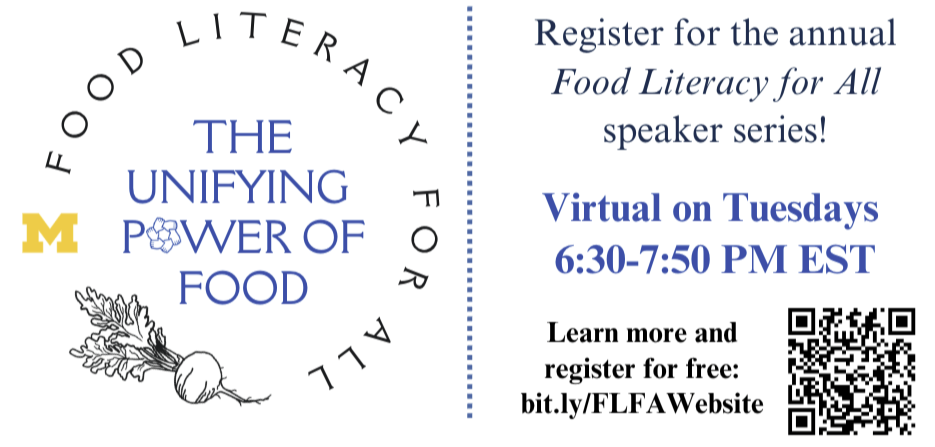
Food Literacy for All is a community-academic partnership course at the University of Michigan, now in its 10th year.
From January to April, Food Literacy for All features a dynamic session each Tuesday evening (6:30-7:50 pm ET) that addresses the challenges and opportunities of diverse food systems. All sessions are on Zoom and recordings are shared afterward.
Upcoming sessions: - April 7: The Farmers Land Trust and the Farmland Commons: A New Model for Land Access, Ownership & Tenure
-
April 14: Fast Food for Thought with Ten UM Faculty 5-minute Flash Talks (hybrid event)
- April 21: Course Reflection
See the schedule and register for free as a community member on the website. Registration is rolling, so you can sign up anytime and attend the sessions that interest you. Register once and received reminders of each week's webinar.
|
|
|
|
Following up on the 7th JAFSCD Community Annual General Meeting on March 18, notes and links to the recording and slide deck are here. We welcome you to catch up on JAFSCD's activities and community news!
|
|
|
This email is sent to you as a notification of the newest JAFSCD articles and other occasional JAFSCD news. |
|
JAFSCD is an open access, community-supported journal! Your library, program, or organization can become a shareholder to help keep JAFSCD's content available to all, regardless of their resources. We welcome anyone to become an individual shareholder; donations are tax-deductible to the extent allowed by law.
|
|
|
|