from the Journal of Agriculture, Food Systems, and Community Development |
|
|
JAFSCD is the world’s only community-supported journal. JAFSCD content is open access (free) thanks to the generous support of our shareholders: the JAFSCD Shareholder Consortium, Library Shareholders, a growing number of Individual Shareholders, and our JAFSCD Partners: |
|
|
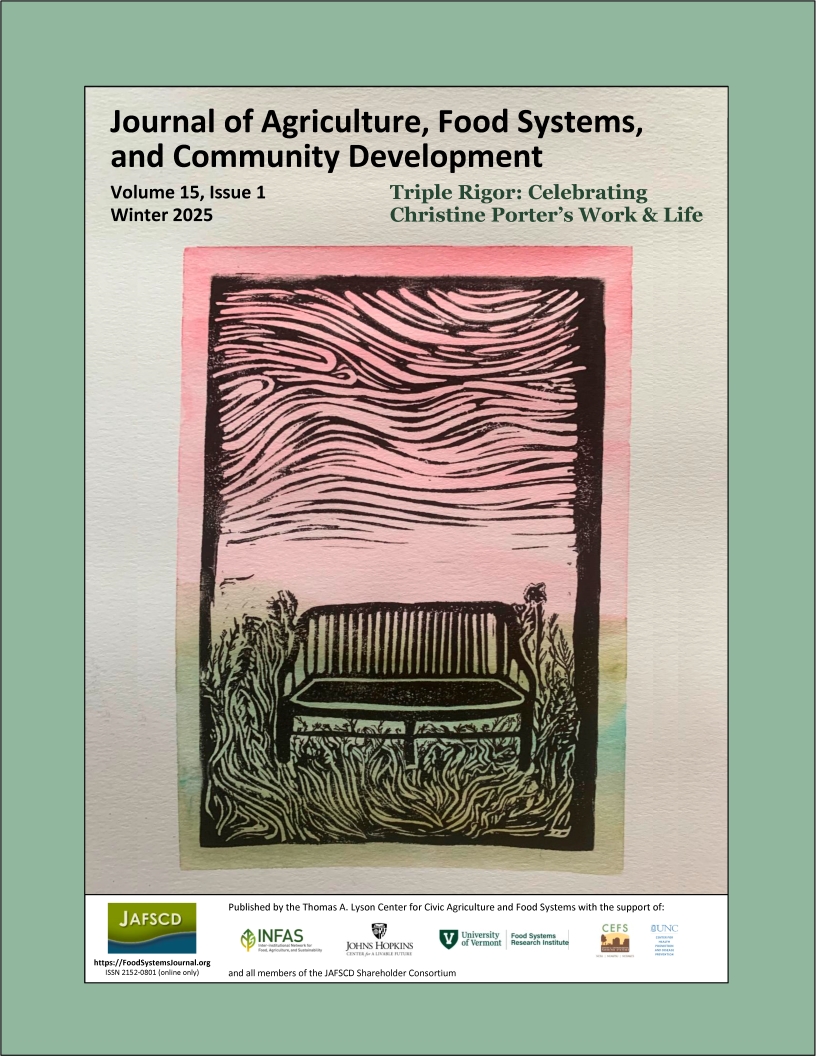
The cover of JAFSCD's winter issue depicts Dr. Christine M. Porter’s vision of the bench where friends and loved ones could visit her into the future, which inspired this linocut print by Shannon Conk.
|
|
The winter issue of JAFSCD includes a special section of articles in a festschrift* for Christine M. Porter, PhD. She was Wyoming Excellence Chair and Professor of Community and Public Health at the University of Wyoming. She focused on community food systems strategies for improving equity, health, and democracy, and investing in strategies to diversify who is leading that work. In her honor, the festschrift celebrates her life and work, including by applying her framework for blending epistemological, ethical, and emotional rigor in research for identifying truth and fostering transformation—what she called triple-rigorous research and storytelling.
*A festschrift is a collection of writings published in honor of a scholar. |
|
|
JAFSCD peer-reviewed article by Rachael Budowle (Virginia Tech), Ben Cousineau (Emory University), Michelle Miller (University of Wisconsin-Madison) Julie Grossman (University of Minnesota), and Brandy E. Phipps (Central State University)
Endowed by the W.K. Kellogg Foundation, INFAS connects scholars, educators, and action-researcher activists across the U.S. to envision an environmentally sustainable and socially just food system. In 2023, 12 past and current members engaged in a facilitated “strategic storytelling” process to collectively understand the more than 15-year past and present of INFAS before planning for its future.
In a new JAFSCD article, Strategic storytelling: Reflecting on the past, present, and future of INFAS, authors Budowle, Cousineau, Miller, Grossman, and Phipps share that story organized by broad chapters: Prologue: Influences & Origins; Chapter 1: Formalizing the Network; Chapter 2: Reorienting Toward Equity; Chapter 3: Reorganizing to Do the Work; and an Epilogue focused on long-term goals to integrate community leaders in the network and support underrepresented scholars and students despite ongoing productive tensions and constraints.
Corresponding author Rachael Budowle can be contacted at rbudowle@vt.edu. KEY FINDINGS - The prologue, from the 1980s to the early 2000s, coalesced a loose network of academics committed to sustainable agriculture.
-
Chapter 1, from approximately 2009 to 2012, formalized and endowed INFAS as a network (mainly including endowed chairs at 1862 land-grant universities at the time), developing a mission and governance structure.
-
Chapter 2, from 2012 to 2019, reoriented INFAS toward equity alongside environmental sustainability through workshops, panels, the INFAS Statement on Equity in the Food System, the Deeper Challenge of Change INFAS supplement, and piloting graduate student fellowship and mentorship program.
-
Chapter 3, from 2020 until 2024, reorganized INFAS to better do its core work through a working-group–led structure and concrete projects.
-
A move toward a more inclusive membership (students, minority-serving institutions, and non-academic organizations and networks) and leadership structure (e.g., electing a community leader to an at-large executive committee member role) has led to a surge in and more engagement with members over time.
-
Time and capacity constraints, academic incentive structures, working within bureaucratic higher education institutions, and remaining a predominately academic network are tensions that affect the long-term systems-level change that INFAS members seek.
RECOMMENDATIONS FOR POLICY, PRACTICE, AND RESEARCH
Strategic storytelling included three key components aligned with Porter’s (2018) triple-rigorous storytelling (emotional, ethical, and epistemological) concept: -
Making intentional space for participants to share their own narratives about what brings them to the shared work, forming stronger relationships with each other;
- Collaboratively telling a narrative network history with past and current leaders to facilitate shared understanding of the work, articulating collective values; and
-
Creating an outward-facing narrative product to share that story with other members and partners.
Other networks and organizations may apply and adapt our three strategic storytelling components as as an alternative to strategic planning. Strategic storytelling may be particularly useful for on-boarding new leaders and moving out of major reorganizational chapters without attachment to defining specific future action steps in other higher education contexts and in organizations that function as diffuse networks, like INFAS. SHARE ON YOUR SOCIALS
INFAS, strategic storytelling, and the legacy of Dr. Christine Porter. "Christine would urge and support us and others to do what she called “the capital-W Work of justice.” For INFAS, strategic storytelling included three key components, all of which align in some way with Christine’s concept of triple-rigorous storytelling and research—emotional, ethical, and epistemological. To learn more about INFAS as a working group and methodology for strategic storytelling, read the @JAFSCD for free at https://doi.org/10.5304/jafscd.2025.151.029.
|
|
|
Photo above: At the Wyoming Food Coalition 2024 Fall Conference, a tasting of local foods was a hit. Photo courtesy of the Wyoming Food Coalition. |
|
|
JAFSCD SHAREHOLDER'S EVENT |
|
|
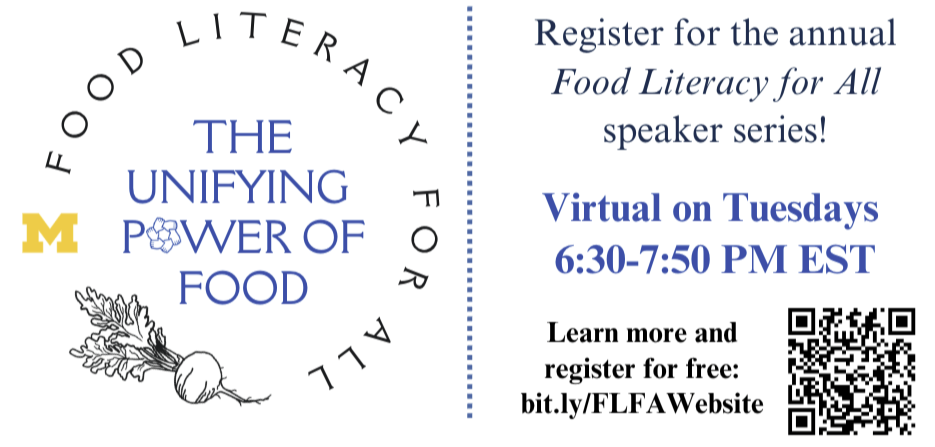
The 10th anniversary series of Food Literacy for All kicks off on January 13, with guest speakers starting on January 20. Food Literacy for All is a community-academic partnership course at the University of Michigan.
From January to April, Food Literacy for All features dynamic sessions each Tuesday evening (6:30-7:50 pm ET) that address the challenges and opportunities of diverse food systems.
The first session on Jan. 13 gives an overview of food systems and reviews the syllabus and assignments (community members don’t need to attend the whole session). The guest speakers start on January 20. All sessions are on Zoom and recordings are shared afterward.
See the schedule and register for free as a community member on the website. Registration is rolling, so you can sign up anytime. As a registrant, you can attend the sessions that interest you. You register once and will get reminders of each week's webinar. |
|
|
This email is sent to you as a notification of the newest JAFSCD articles and other occasional JAFSCD news. |
|
JAFSCD is an open access, community-supported journal! Your library, program, or organization can become a shareholder to help keep JAFSCD's content available to all, regardless of their resources. We welcome anyone to become an individual shareholder; donations are tax-deductible to the extent allowed by law.
|
|
|
|