from the Journal of Agriculture, Food Systems, and Community Development |
|
|
JAFSCD is the world’s only community-supported journal. JAFSCD content is open access (free) thanks to the generous support of our shareholders: the JAFSCD Shareholder Consortium, Library Shareholders, a growing number of Individual Shareholders, and our JAFSCD Partners: |
|
|
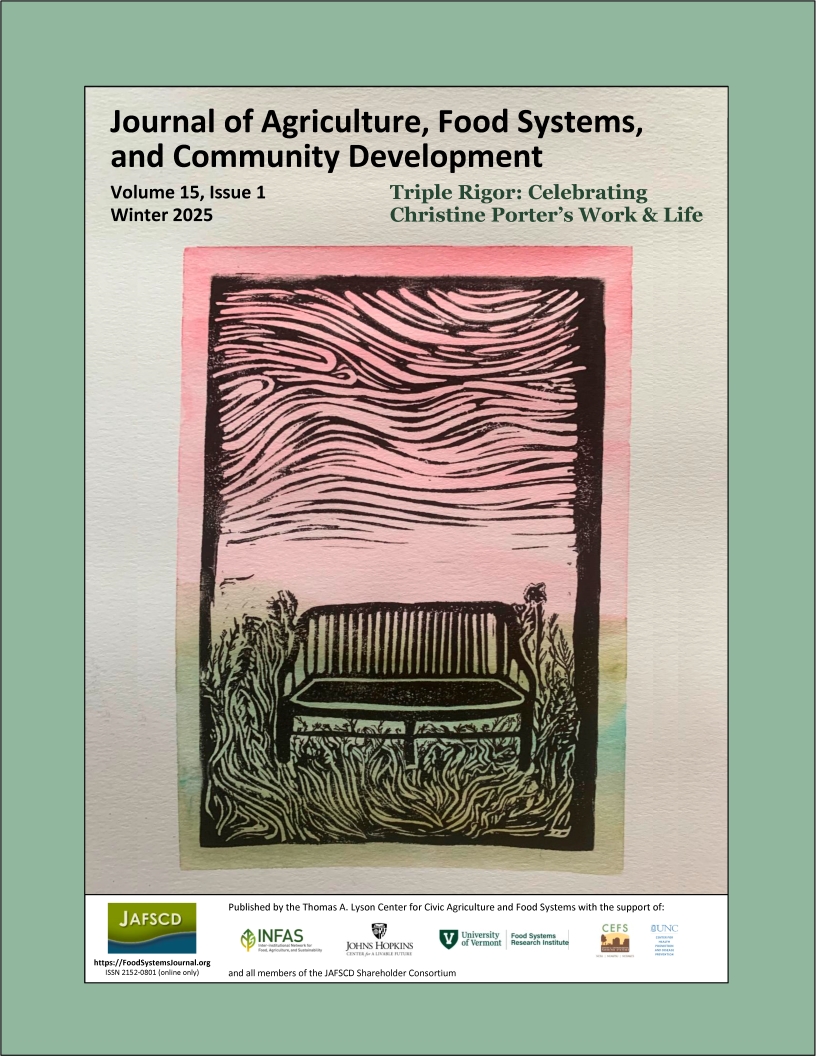
The cover of JAFSCD's winter issue depicts Dr. Christine M. Porter’s vision of the bench where friends and loved ones could visit her into the future, which inspired this linocut print by Shannon Conk.
|
|
The winter issue of JAFSCD includes a special section of articles in a festschrift* for Christine M. Porter, PhD. She was Wyoming Excellence Chair and Professor of Community and Public Health at the University of Wyoming. She focused on community food systems strategies for improving equity, health, and democracy, and investing in strategies to diversify who is leading that work. In her honor, the festschrift celebrates her life and work, including by applying her framework for blending epistemological, ethical, and emotional rigor in research for identifying truth and fostering transformation—what she called triple-rigorous research and storytelling.
*A festschrift is a collection of writings published in honor of a scholar. |
|
|
Christine Porter called for three forms of rigor — emotional, ethical, and epistemological — to be applied to academic research about sustainable food systems. The triple-rigor framework raises questions about how researchers practice science, which in turn raises questions about how scientists learn.
In a new JAFSCD article, Triple rigor, Braiding Sweetgrass, and Food Dignitylessons for eighth grade earth science and beyond, Katharine (Katie) Bradley describes teaching practices that help to achieve three goals for students: - recognize that science is a worldview — just one way of knowing among many — and is not superior to any other;
- build capacity to grapple with complexity and use systems thinking to understand "wicked" problems; and
-
use science as a tool for social and environmental justice.
These teaching practices include mapping activities, systems thinking, concept maps, and global perspectives, with attention to gratitude and humility. Bradley draws on personal experiences as a research assistant and postdoctoral scholar on the Food Dignity project, Christine Porter’s mentorship and scholarship, and Robin Wall Kimmerer’s book Braiding Sweetgrass: Indigenous Wisdom, Scientific Knowledge, and the Teachings of Plants (2015).
Katie Bradley can be contacted at kbradley@brooklynfriends.org KEY FINDINGS
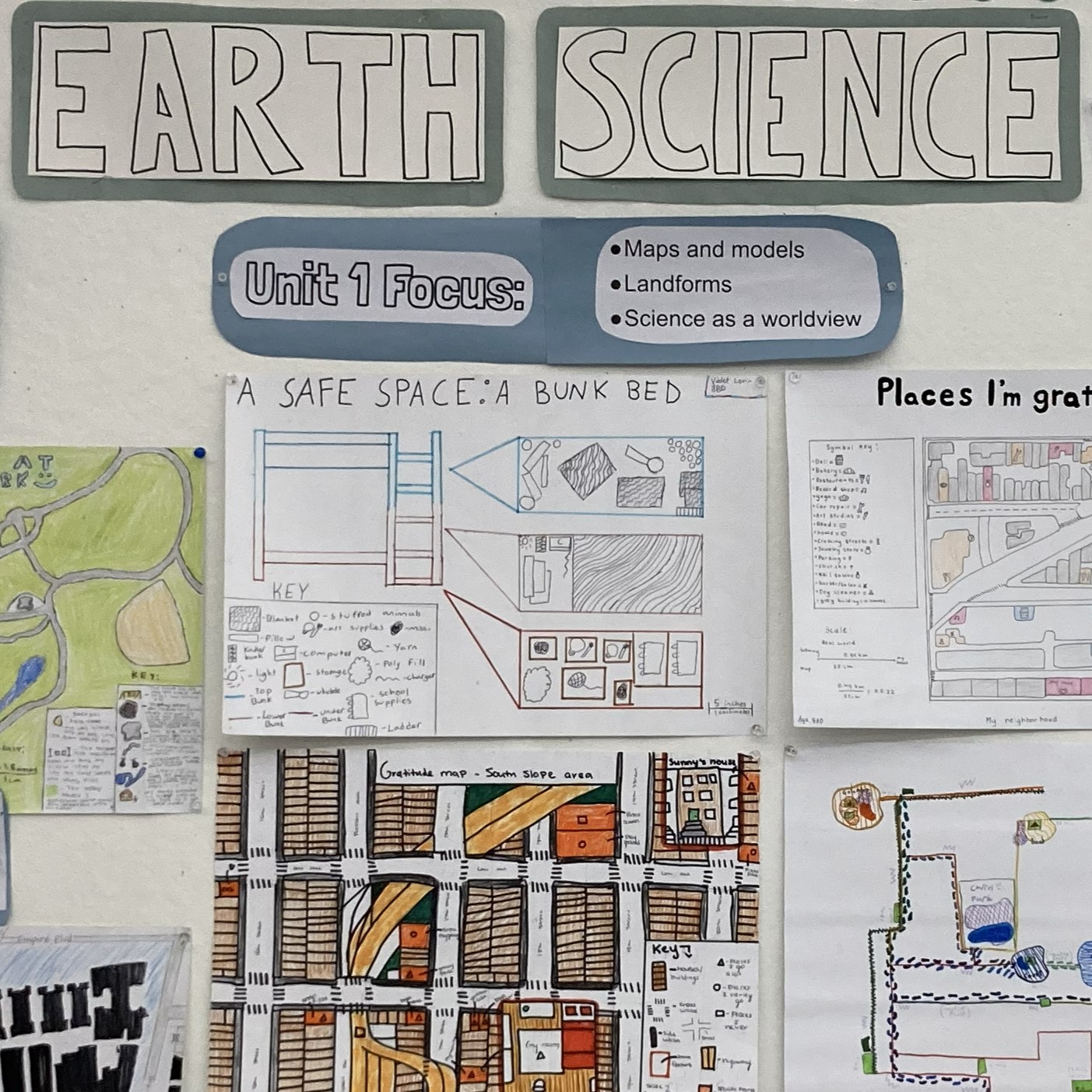
By studying maps as an introduction to earth science topics, students connect the subjectivity of map-making with gratitude, diverse worldviews, and strong objectivity (Harding, 1991) in science.
Concept mapping, initially about student’s own lives and eventually related to climate change effects and adaptations, helps students to see and think about the world holistically. Rethinking something they value by making it the focus of a concept map can help foster humility, revealing a surprising way in which an eighth grader’s capacity to grapple with complexity and emotional rigor go hand in hand. Visualizing system components on different scales, their interconnections, and their functions helps students to focus on the broader contexts of climate science as well as its mechanisms.
Students learn that science can be a tool for justice by using individual action, collective action, and systems change as central concepts to make recommendations for addressing local air quality, research strategies to mitigate climate change, and suggest action steps related to their science fair projects.
RECOMMENDATIONS FOR POLICY, PRACTICE, AND RESEARCH
Scientists of all ages must recognize and honor diverse ways of knowing, take responsibility for what scientific methods and findings do in the real world, and come to the Work with humility and self-awareness. Triple rigor needn’t be advanced; students of every age can learn to practice triple rigor if they are taught. Teachers at all levels should validate and encourage this approach. Teachers doing this work or interested in learning to do so are encouraged to join a broader network of similarly minded educators by contacting the author.
SHARE ON YOUR SOCIALS In a new JAFSCD article, “Triple rigor, Braiding Sweetgrass, and Food Dignity
lessons for eighth grade earth science and beyond,” author Katie Bradley describes practices in the eighth grade earth science class that she designs and teaches at @brooklyfriendsschool. In the article, she describes how she helps her students learn to view science as a worldview, practice systems thinking, and use science as a tool for justice. She draws on important lessons learned from Dr. Christine Porter’s mentorship, the Food Dignity Project, and #BraidingSweetgrass by @Robinwallkimmerer Read the entire @JAFSCD article for free: https://doi.org/10.5304/jafscd.2025.151.032
|
|
|
Photo above: An earth science fair exhibit at Brooklyn Friends Middle School reflects concepts of triple-rigorous research. Photo by Katharine Bradley. |
|
|
JAFSCD SHAREHOLDER'S EVENT |
|
|
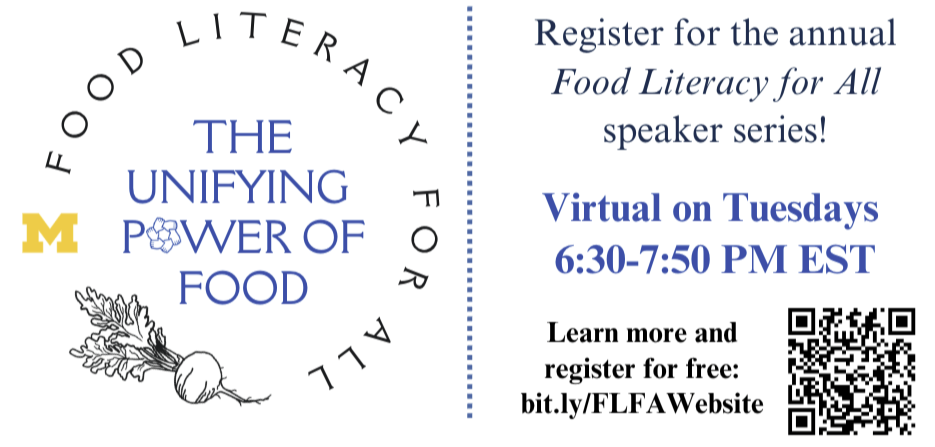
The 10th anniversary series of Food Literacy for All kicks off on January 13, with guest speakers starting on January 20. Food Literacy for All is a community-academic partnership course at the University of Michigan.
From January to April, Food Literacy for All features dynamic sessions each Tuesday evening (6:30-7:50 pm ET) that address the challenges and opportunities of diverse food systems.
The first session on Jan. 13 gives an overview of food systems and reviews the syllabus and assignments (community members don’t need to attend the whole session). The guest speakers start on January 20. All sessions are on Zoom and recordings are shared afterward.
See the schedule and register for free as a community member on the website. Registration is rolling, so you can sign up anytime. As a registrant, you can attend the sessions that interest you. You register once and will get reminders of each week's webinar. |
| |
JAFSCD SHAREHOLDER'S EVENT |
|
|
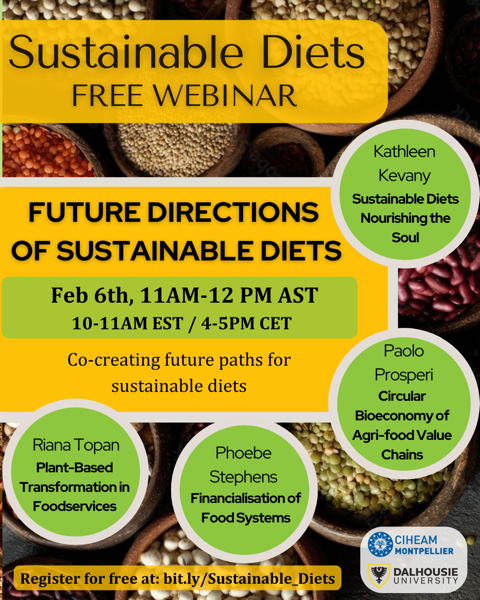
How can we co-create paths toward sustainable diets?
Join Dalhousie University (Canada) and CIHEAM Montpellier (France) on Friday, February 6 (10-11am ET), for a discussion with researchers dedicated to collaborative and impactful strategies for better food futures. |
|
|
This email is sent to you as a notification of the newest JAFSCD articles and other occasional JAFSCD news. |
|
JAFSCD is an open access, community-supported journal! Your library, program, or organization can become a shareholder to help keep JAFSCD's content available to all, regardless of their resources. We welcome anyone to become an individual shareholder; donations are tax-deductible to the extent allowed by law.
|
| |
|