from the Journal of Agriculture, Food Systems, and Community Development |
|
|
JAFSCD is the world’s only community-supported journal. JAFSCD content is open access (free) thanks to the generous support of our shareholders: the JAFSCD Shareholder Consortium, Library Shareholders, a growing number of Individual Shareholders, and our JAFSCD Partners: |
|
|
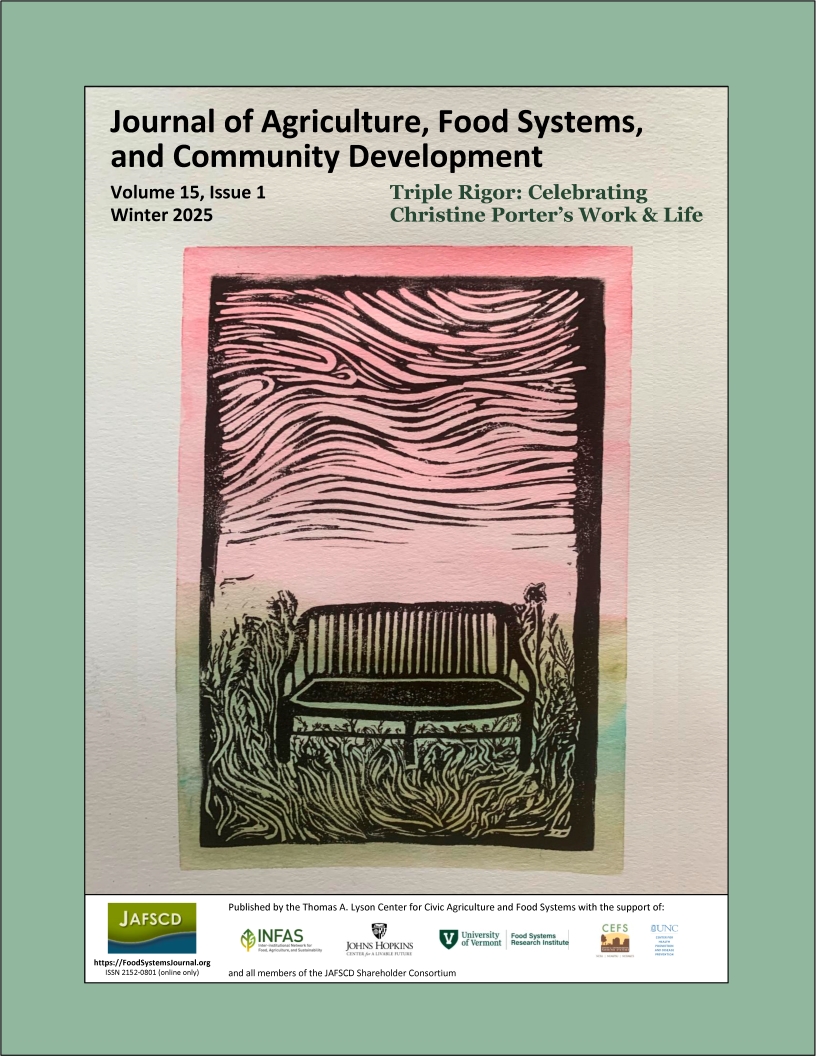
The cover of JAFSCD's winter issue depicts Dr. Christine M. Porter’s vision of the bench where friends and loved ones could visit her into the future, which inspired this linocut print by Shannon Conk.
|
|
The winter issue of JAFSCD includes a special section of articles in a festschrift* for Christine M. Porter, PhD. She was Wyoming Excellence Chair and Professor of Community and Public Health at the University of Wyoming. She focused on community food systems strategies for improving equity, health, and democracy, and investing in strategies to diversify who is leading that work. In her honor, the festschrift celebrates her life and work, including by applying her framework for blending epistemological, ethical, and emotional rigor in research for identifying truth and fostering transformation—what she called triple-rigorous research and storytelling.
*A festschrift is a collection of writings published in honor of a scholar. |
|
|
Talking circles as an evaluation method
JAFSCD article by Jill F. Keith (University of Wyoming), Rachael Budowle (Virginia Tech), Tarissa L. Spoonhunter (University of Wyoming), Reinette R. Curry (University of Wyoming), Christine Porter (University of Wyoming)
Utilizing a culturally appropriate approach to program evaluation |
| |
|
Despite rich contributions to higher education and the need for new and more diverse strategies to improve the sustainability, productivity, and health impacts of our nation’s food and agriculture systems, American Indian/Alaska Native (AI/AN) students only make up 0.7% of college student enrollment and dropout rates continue to rise. While inherent resilience and key support systems such as family and peers are common among AI/AN students, they experience multiple barriers to success in higher education, including in the food, agriculture, nutrition, and health sciences (FANH) fields.
In a new JAFSCD article, Growing season: A talking circle evaluation of American Indian/Alaska Native student pathways to food systems and sovereignty higher education in Wyoming, authors Keith, Budowle, Spoonhunter, Curry, and Porter (posthumously) present a program evaluation strategy of a culturally appropriate talking circle approach grounded in an Indigenous research paradigm.
Corresponding author Keith can be contacted at jkeith5@uwyo.edu. KEY FINDINGS - Program successes include themes of people, relationships, and belonging and cultural competence.
-
Program challenges include capacity and defining student success.
- Program hopes include themes of communication and alignment.
RECOMMENDATIONS FOR POLICY, PRACTICE, AND RESEARCH
While this internal holistic evaluation may not be broadly generalized to all higher education institutions, the authors find it to be based deeply in relational accountability in ways that make it relevant within an Indigenous research paradigm and likely for supporting AI/AN students in other contexts. Accordingly, they share the following insights for others engaged in AI/AN student mentoring and recruiting programs: - Relationships between project leaders, team members, and students are key. Nurture them through good communication to help support both the project’s goals and AI/AN students’ feelings of belonging.
-
Relationships between project team members at the higher education institution and tribal community members are also key. Communication, support, and inclusion are important for supporting AI/AN students and pathways to FANH.
-
Planning well so that activities complement other work to support AI/AN students is important to avoid conflict, over scheduling students and team members, and time restrictions for including community voices.
-
Flexibility with how to define program and student success, and being able to communicate that with campus leaders, tribal leadership, community members, and the broader academic community, are essential.
SHARE ON YOUR SOCIALS
In a new JAFSCD article, “Growing Season: A talking circle evaluation of American Indian/Alaska Native student pathways to food systems and sovereignty higher education in Wyoming," researchers found that talking circles helped to support relationships through mentoring sessions and other experiential learning and events both on and off campus. To read more on this approach, read the @JAFSCD for free: https://doi.org/10.5304/jafscd.2025.151.028
#Indigenous #UofWyoming #Mentorship #AI/AN #collegestudents #highereducation |
|
|
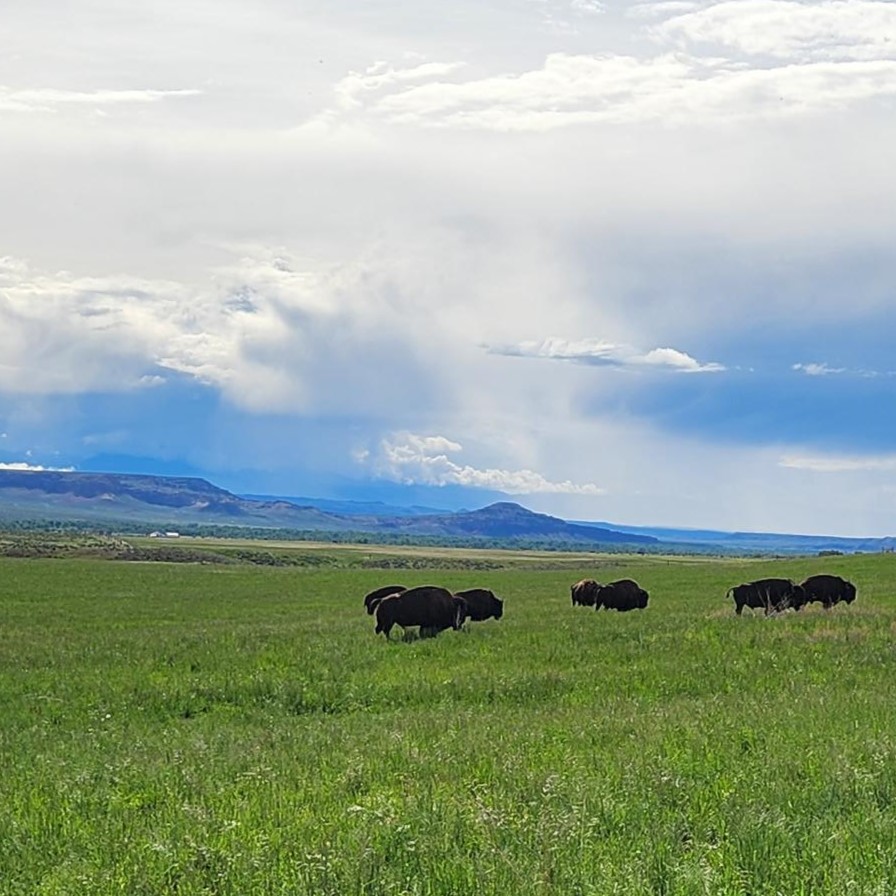
Image above: Buffalo on the Wind River Tribal Buffalo Initiative (WRTBI) on the Wind River Indian Reservation in Wyoming. Engagement with the WRTBI supported Traditional Ecological Knowledge (TEK) at a workshop through the USDA-funded Growing Season program. Photo by Jill Keith. |
|
|
JAFSCD SHAREHOLDER'S EVENT |
|
|
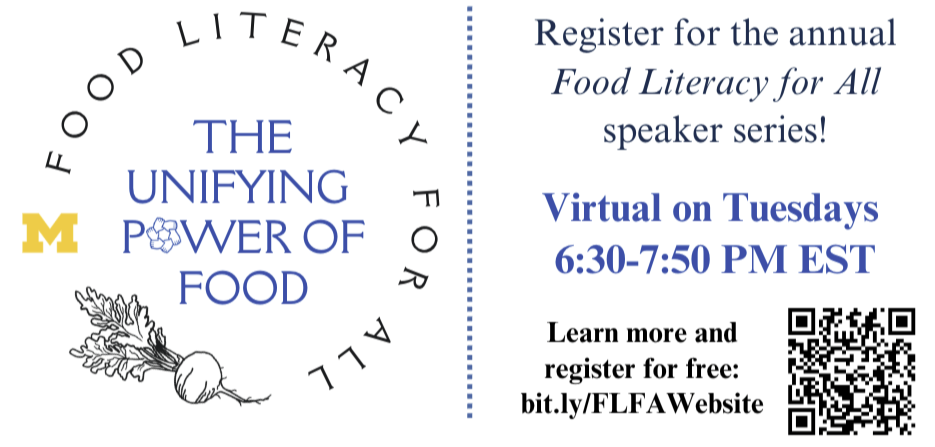
The 10th anniversary series of Food Literacy for All kicks off on January 13, with guest speakers starting on January 20. Food Literacy for All is a community-academic partnership course at the University of Michigan.
From January to April, Food Literacy for All features dynamic sessions each Tuesday evening (6:30-7:50 pm ET) that address the challenges and opportunities of diverse food systems.
The first session on Jan. 13 gives an overview of food systems and reviews the syllabus and assignments (community members don’t need to attend the whole session). The guest speakers start on January 20. All sessions are on Zoom and recordings are shared afterward.
See the schedule and register for free as a community member on the website. Registration is rolling, so you can sign up anytime. As a registrant, you can attend the sessions that interest you. You register once and will get reminders of each week's webinar. |
| |
JAFSCD SHAREHOLDER'S EVENT |
|
|
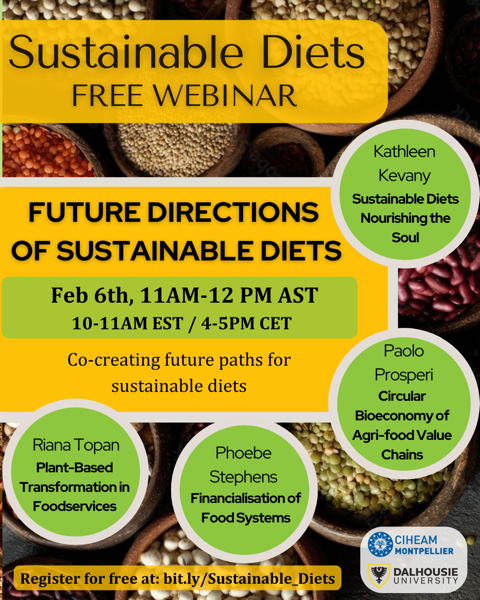
How can we co-create paths toward sustainable diets?
Join Dalhousie University (Canada) and CIHEAM Montpellier (France) on Friday, February 6 (10-11am ET), for a discussion with researchers dedicated to collaborative and impactful strategies for better food futures. |
|
|
This email is sent to you as a notification of the newest JAFSCD articles and other occasional JAFSCD news. |
|
JAFSCD is an open access, community-supported journal! Your library, program, or organization can become a shareholder to help keep JAFSCD's content available to all, regardless of their resources. We welcome anyone to become an individual shareholder; donations are tax-deductible to the extent allowed by law.
|
| |
|