from the Journal of Agriculture, Food Systems, and Community Development |
|
|
JAFSCD is the world’s only community-supported journal. JAFSCD content is open access (free) thanks to the generous support of our shareholders: the JAFSCD Shareholder Consortium, Library Shareholders, a growing number of Individual Shareholders, and our JAFSCD Partners: |
|
|
From the staff and volunteers at JAFSCD, we wish you a season of rest, renewal, and connection. |
|
|
The winter issue of JAFSCD includes a festschrift* for Christine M. Porter, PhD. She was Wyoming Excellence Chair and Professor of Community and Public Health at the University of Wyoming. She focused on community food systems strategies for improving equity, health, and democracy, and investing in strategies to diversify who is leading that work. In her honor, the festschrift celebrates her life and work, including by applying her framework for blending epistemological, ethical, and emotional rigor in research for identifying truth and fostering transformation—what she called triple-rigorous research and storytelling.
|
* A festschrift is a collection of writings published in honor of a scholar. |
|
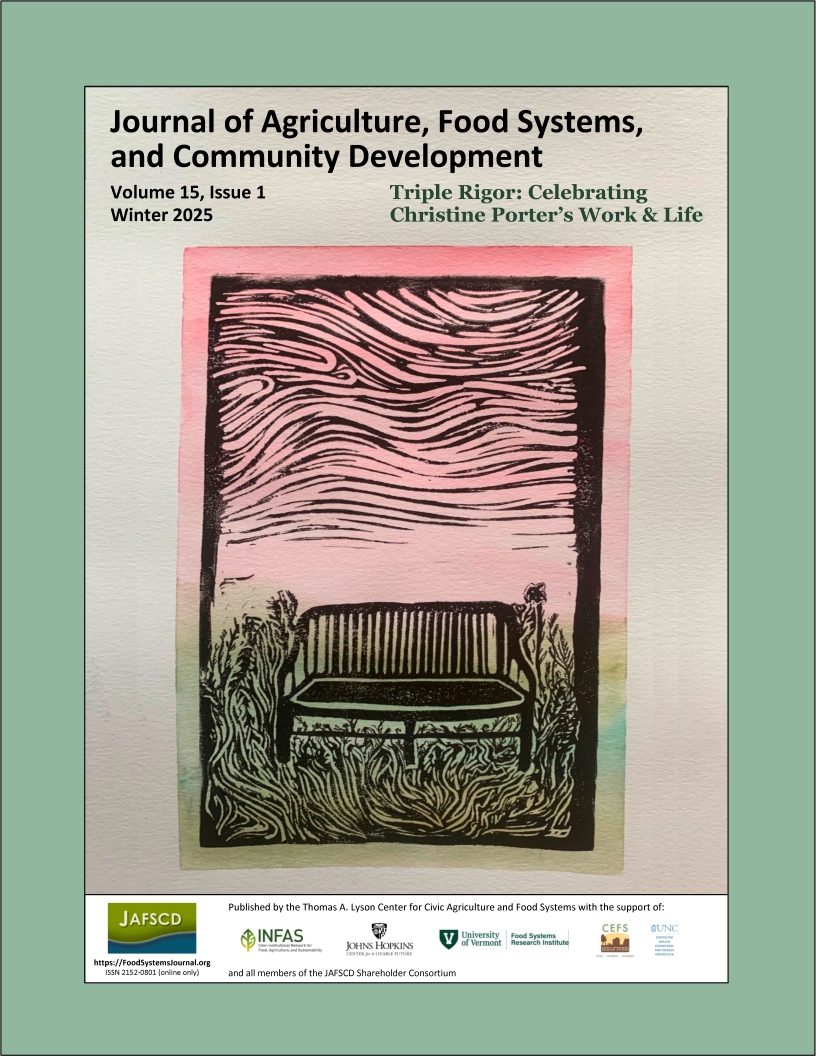
The cover of JAFSCD's winter issue depicts Dr. Christine M. Porter’s vision of the bench where friends and loved ones could visit her into the future, which inspired this linocut print by Shannon Conk. |
|
|
|
Celebrating lessons and carrying on legacies from Christine M. Porter
Compilation of vignettes by Patti Provance, Megan M. Gregory, Lacey Gaechter, Alyssa Wechsler Duba, Shannon Conk, Ben Cousineau, Lindsey Lunsford, Erica Hall, Derek T. Smith, Katherine McKinney, Denyse Ute, and Sarah Konrad (edited by Rachael Budowle and Lacey Gaechter) |
|
|
"This compilation of vignettes emerged from an invitation to share and celebrate food justice and other lessons and legacies connected with Christine M. Porter, as she prepared to walk on in 2024. Twelve authors who considered her a mentor, colleague, collaborator, and/or friend have each contributed a unique written or visual vignette in response to this invitation. Collectively, these vignettes share throughlines that weave a narrative of how Christine lived, worked, led, learned, taught, and loved. Many describe how she embraced them as whole people—empowering, mentoring out and up, and actively inviting them into otherwise exclusive communities and professional pursuits.
"Several also speak to how Christine illuminated the white supremacist, patriarchal, and capitalist systems that keep people from those pursuits, among other injustices. They detail her commitment to the “Capital-W Work” of social justice in response to and against those systems. In short, Christine had an extraordinary ability to see these systems that rely on their own invisibility to continue, naming and making them visible for others, while still succeeding within academia. Some link that success to Christine’s concept of triple rigor (ethical, emotional, and epistemological), which allowed her work to flow first from her values—and increasingly from her heart (Budowle & Porter, in press; Porter, 2018). She urged asking questions that mattered, shifted in response to new and compelling evidence, and shared that she made her best decisions out of love despite any fear. . . ."
Read the entire article of vignettes at https://doi.org/10.5304/jafscd.2025.151.025 |
|
|
Photo above: Evergreen on a hillside in fall in Gray's River Canyon, Lincoln County, Wyoming. Photo by Flickr user arbyreed and used under CC BY-NC-SA 2.0 license. |
|
|
|
As a community-supported journal, JAFSCD depends on our community of shareholders, who contribute to keep our content free and freely accessible, worldwide. We appreciate all our new and renewing shareholders! Learn more about joining here.
Our newest JAFSCD Shareholders are: |
|
|
| Farmers markets’ transition to online sales during COVID-19
JAFSCD peer-reviewed article by Edna Ely-Ledesma (University of Wisconsin-Madison) and Hanbing Liang (University of Wisconsin-Madison)
Analysis of and policy recommendations for how online sales platforms can serve as assets to increase farmers markets’ customer pool and the resilience of local food systems across communities. |
| |
During the start of the unprecedented COVID-19 pandemic in spring 2020, supply chain disruptions interfered with existing organizational habits in local farmers markets and other direct-to-consumer (DTC) market channels. In places like Sonoma and Marin counties, California, a series of wildfires and rising operating costs also affected many local producers. DTC channels pivoted to meet consumers in a new, unexpected way, expanding access to, and engaging with, consumers who may not have previously had access to these sales opportunities. This research explores how online sales models at the national, regional, and local levels served to increase community resilience through the adoption of online sales platforms by farmers markets during the COVID-19 pandemic.
In a new JAFSCD article, Farmers markets’ transition to online sales during the COVID-19 pandemic: Case study of Sonoma and Marin counties, California, authors Edna Ely-Ledesma and Hanbing Liang present findings from a regional and national research study that aimed to explore how farmers markets operations using online sales platforms, best online sales practices, and how online sales increased consumers’ access in Sonoma and Marin counties in California and nationally. Corresponding author Edna Ely-Ledesma can be contacted at eledesma@wisc.edu.
KEY FINDINGS -
At the national level, the study found that most market platforms were concentrated in metropolitan and urban regions, while those in rural areas were typically located in agriculturally rich regions.
-
The study found limited availability of nutrition incentive programs online. At the state level, only about 15% of WIC-certified farmers markets in California utilized different online platforms for the purpose of marketing, additional sales channel, or both.
-
Locally, in Sonoma and Marin counties, the online sales from ACE farmers markets during the height of the pandemic in 2020 helped sustain vendor sales and maintain access for customers during a period of restricted in-person shopping.
RECOMMENDATIONS FOR POLICY, PRACTICE, AND RESEARCH
- Models that offer greater flexibility—such as sliding-scale pricing or multiple fulfillment options—may provide more feasible access points for consumers with differing needs.
-
Online service platforms may benefit from operating at a certain scale or developing collaborative networks in order to be more sustainable and useful for both producers and consumers.
-
Expanding nutrition incentive programs to cover online purchases could further reduce barriers for low-income consumers, particularly those with limited mobility or transportation access.
-
"Scaffolding" is important in addressing the digital divide to enable new users of online platforms. Whether rural or urban, cost, technology, and training is required to democratize the use of digital platforms. Efforts that integrate government and nonprofits are needed to support low-income, low-access populations, whether rural or urban.
SHARE ON YOUR SOCIALS
How did the change to online sales platforms affect sales at farmers markets during COVID-19? And what can we learn about best practices? Read the full @JAFSCD article that looks at Sonoma and Marin counties, California, for free: https://doi.org/10.5304/jafscd.2025.151.013 #farmersmarkets #covid19 #pandemic #onlinesales #directtoconsumer #California
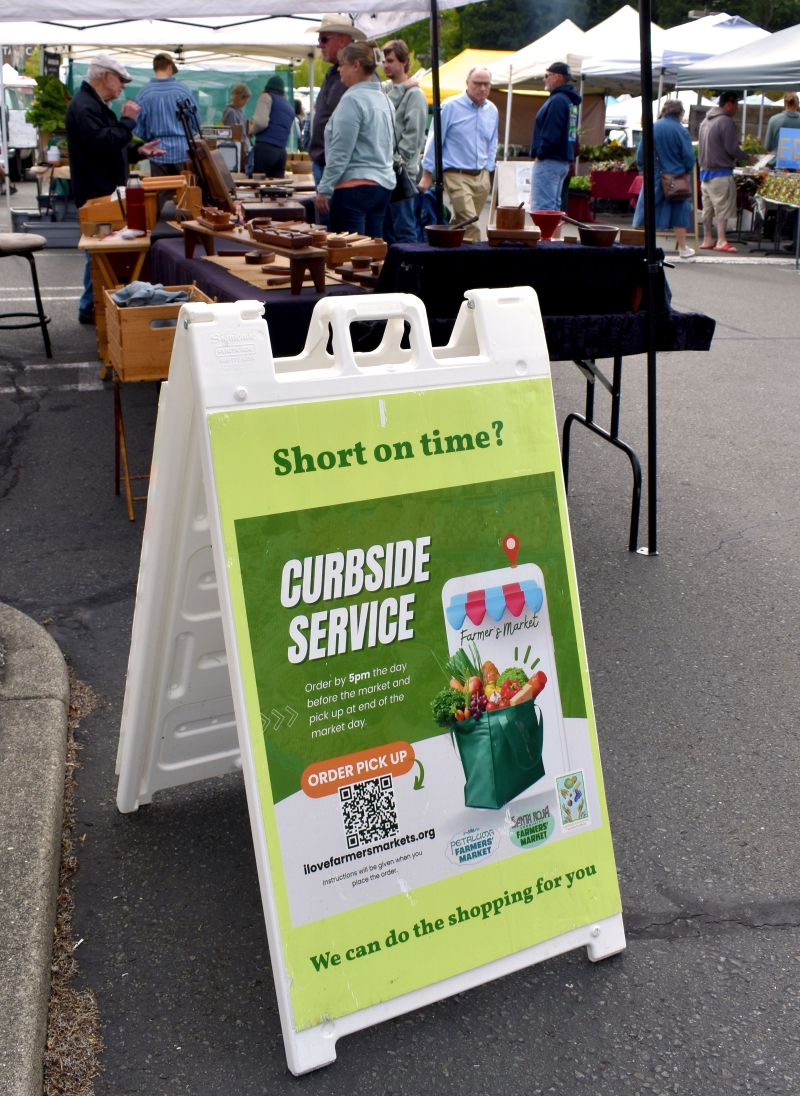
Photo above: Curbside pickup for online orders at the Santa Rosa (California) Community Farmers Market. Photo provided by the authors. |
|
|
SUPPORT JAFSCD THROUGH YOUR LIBRARY! |
|
|
| If you are affiliated with a college or university and want to support JAFSCD, now is the time of year when libraries order new journal subscriptions. |
|
|
How do I know if my library already contributes? Check the list here (scroll down on the page).
Isn't JAFSCD open access and free? It is! But we are a community-supported journal. Libraries contribute to become JAFSCD Library Shareholders instead of buying a subscription — keeping JAFSCD free to all instead of buying access just for their faculty and students. Think of us as the CSA of journals!
Considering submitting a manuscript to JAFSCD? If your institution is a JAFSCD Shareholder, you benefit by having our US$750 APC waived automatically.
How do I recommend JAFSCD to my library? Tell your librarian why JAFSCD is important to your work, and send them this link to learn more!
Contact Amy Christian, managing editor, for details or assistance. |
|
|
This email is sent to you as a notification of the newest JAFSCD articles and other occasional JAFSCD news. |
|
JAFSCD is an open access, community-supported journal! Your library, program, or organization can become a shareholder to help keep JAFSCD's content available to all, regardless of their resources. We welcome anyone to become an individual shareholder; donations are tax-deductible to the extent allowed by law.
|
|
|
|