from the Journal of Agriculture, Food Systems, and Community Development |
|
|
JAFSCD is the world’s only community-supported journal. JAFSCD content is open access (free) thanks to the generous support of our shareholders: the JAFSCD Shareholder Consortium, Library Shareholders, a growing number of Individual Shareholders, and our JAFSCD Partners: |
|
|
The winter issue of JAFSCD includes the first set of articles and commentaries published in a festschrift* for Christine M. Porter, PhD. She was Wyoming Excellence Chair and Professor of Community and Public Health at the University of Wyoming. She focused on community food systems strategies for improving equity, health, and democracy, and investing in strategies to diversify who is leading that work. In her honor, the festschrift celebrates her life and work, including by applying her framework for blending epistemological, ethical, and emotional rigor in research for identifying truth and fostering transformation—what she called triple-rigorous research and storytelling.
|
* A festschrift is a collection of writings published in honor of a scholar. |
|
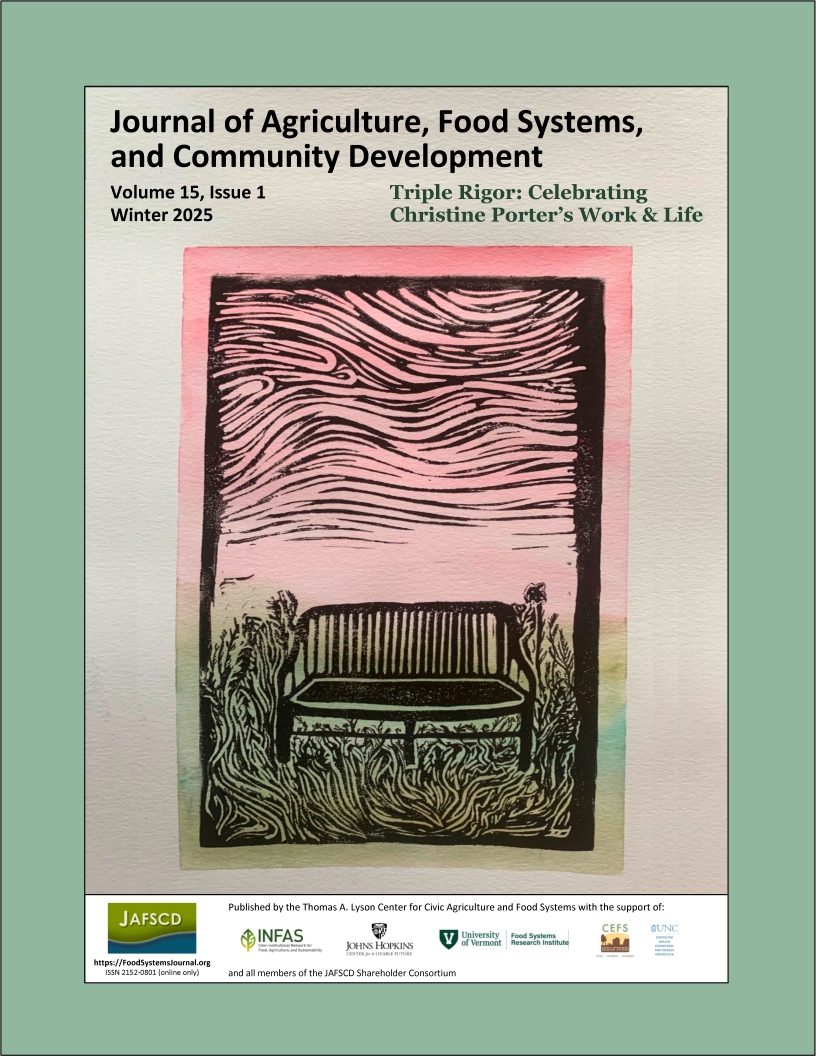
The cover of JAFSCD's winter issue depicts Dr. Christine M. Porter’s vision of the bench where friends and loved ones could visit her into the future, which inspired this linocut print by Shannon Conk. |
|
|
In Love as praxis: Academic and activist pathways to food justice, author Lesli Hoey reminds us that in this politically divided moment, when cruelty is regularly the dominant headline, civil rights leaders have long taught that liberation and deliberation are impossible without a grounding in love.
Hoey contributes to a special section of JAFSCD honoring Christine Porter’s work by revising a past interview she conducted with Detroit food justice activist Charity Hicks. Far from an abstract ideal, Hoey argues that the love as praxis that drove both Christine and Charity’s work—based on practical strategies like a relational root cause analysis, ethical humility, and emotional rigor—should fuel scholars and activists to not only transform the food system, but to also “leverage the food system,” as Charity put it. It could help navigate this precarious political moment to unite and collectively build a more just society.
KEY FINDINGS
Christine and Charity led food systems change from two distinct but complementary positions: the former, a scholar trying to break down “academic supremacy” to leverage the resources and skill sets of academics to be of genuine use to historically marginalized and exploited communities, and the latter an activist working to instigate structural change while building the tools for grassroots voices to assert their own agency. Ongoing challenges and recent progress in Detroit’s food movement show that Charity’s concerns—and her vision for food justice—remain relevant today.
Taking a cue from Christine, who argued for "flipping the script" in academia so that community leaders are given a greater platform to share their instinctual social theories, the format of this reflective essay—a deep analysis of a single interview—is itself instructional.
RECOMMENDATIONS FOR POLICY, PRACTICE, AND RESEARCH
Looking at Charity’s and Christine’s perspectives together suggests that academics, activists, and policy actors could better address food system issues by combining epistemological, ethical, and emotional rigor—the “triple-rigorous storytelling” Christine advocated. SHARE ON YOUR SOCIALS
In a special section of JAFSCD dedicated to Dr. Christine Porter, the new article "Love as praxis: Academic and activist pathways to food justice" reminds us that in this politically divided moment, when cruelty is regularly the dominant headline, civil rights leaders have long taught that liberation and deliberation are impossible without a grounding in love. Read the @JAFSCD article for free at https://doi.org/10.5304/jafscd.2025.151.027
#love #foodsystems #socialjustice #triplerigor #storytelling |
|
|
Photo above: A mural created in 2017 near Eastern Market in Detroit, by Rick Williams and Brandan "BMike" Odums. The quote says, “They tried to bury us. They didn’t know we were seeds.” Photo by Lesli Hoey. |
|
|
SUPPORT JAFSCD THROUGH YOUR LIBRARY! |
|
|
|
|
If you are affiliated with a college or university and want to support JAFSCD, now is the time of year when libraries order new journal subscriptions. |
|
|
How do I know if my library already contributes? Check the list here (scroll down on the page).
Isn't JAFSCD open access and free? It is! But we are a community-supported journal. Libraries contribute to become JAFSCD Library Shareholders instead of buying a subscription — keeping JAFSCD free to all instead of buying access just for their faculty and students. Think of us as the CSA of journals!
Considering submitting a manuscript to JAFSCD? If your institution is a JAFSCD Shareholder, you benefit by having our US$750 APC waived automatically.
How do I recommend JAFSCD to my library? Tell your librarian why JAFSCD is important to your work, and send them this link to learn more!
Contact Amy Christian, managing editor, for details or assistance. |
|
|
This email is sent to you as a notification of the newest JAFSCD articles and other occasional JAFSCD news. |
|
JAFSCD is an open access, community-supported journal! Your library, program, or organization can become a shareholder to help keep JAFSCD's content available to all, regardless of their resources. We welcome anyone to become an individual shareholder; donations are tax-deductible to the extent allowed by law.
|
|
|
|