from the Journal of Agriculture, Food Systems, and Community Development |
|
|
JAFSCD is the world’s only community-supported journal. JAFSCD content is open access (free) thanks to the generous support of our shareholders: the JAFSCD Shareholder Consortium, Library Shareholders, a growing number of Individual Shareholders, and our six JAFSCD Partners: |
|
|
Agency provides explanations for various questions arising in food system resilience work. Numerous frameworks have been proposed to explain and predict the resilience of food systems. Developing good predictive models is crucial for emergency management, food system design, evolutionary biology, and sustainability science.
A new JAFSCD commentary, Agency in resilient local food systems, argues that the most lauded models of resilient food systems in the U.S. leave out one component. Based on his experience in Appalachia, the Mississippi Delta region, and 41 developing countries, the author contends that entrepreneurial agency is necessary for resilient food systems in underdeveloped regions. The article argues that agency may resolve some quandaries which have arisen in studies of resilience in the U.S.:
- The high correlation of resilience with low levels of poverty and high levels of health does not hold in Appalachia.
- Highly resilient communities have arisen adjacent to communities with very low resilience.
-
One area of the U.S. South has proven resilient to climate change, actually decreasing in average annual temperatures in recent years.
KEY RECOMMENDATIONS -
Two subpopulations exist in Appalachia. The former mining communities have low levels of health outcomes, high poverty, and low agency. The much smaller small-farm population has high health, low poverty, and high agency, and accounts for the resilience of the food system.
-
Levels of agency are much higher in highly resilient communities than in the low-resilience counties that surround them.
- Farmers in the climate anomaly area in Southern Arkansas, Louisiana, and Mississippi have used their agency to chose to abandon row crops for forestry. Forested lands are cooler than row crop lands.
This commentary bases its conclusions on qualitative case studies and urges a more systematic and quantitative examination of the interplay of agency and resilience.
SHARE ON YOUR SOCIALS
In our latest JAFSCD commentary, the Resilience Project identified overlapping strengths within the local food systems of 31 case studies. To read author Jim Worstell's full commentary, visit https://doi.org/10.5304/jafscd.2025.151.005. #localfood #resiliency |
|
|
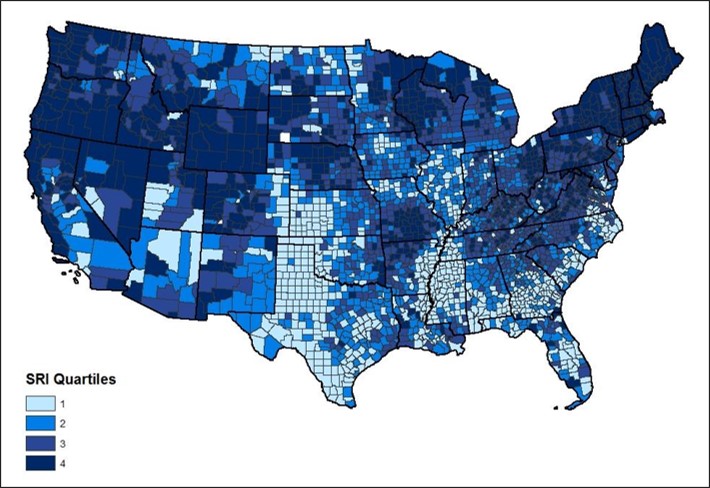
Photo above: Figure 1. Resilience of U.S.CountiesUsing the Sustainability/Resilience Index (SRI)ScoresLighter colored counties had low SRI scores; darker counties had higher SRI scores. The High Plains, Mississippi Delta,and Piedmont plateau stand out as generally low resilience regions, although there are exceptions. |
|
|
Quality seeds are essential for transforming agriculture and helping farmers adapt to climate change. Yet seed-related decisions often exclude smallholder farmers—despite them being end users of agricultural innovations and custodians of local varieties with valuable genetic traits. To build farming systems that can withstand climate challenges, it is essential to understand farmers’ seed preferences and address the barriers that hinder their use of improved seeds. This is not just a matter of equity; it is a strategic imperative for climate-resilient agriculture.
In a new JAFSCD commentary, Dialogue on maize seeds: Are smallholder farmers’ voices heard in building climate-resilient food systems?, Arsene Balasha contributes to the debate on the use of agricultural innovation by amplifying the voice of farmers struggling to access improved seeds, while also highlighting the cultural value of local seeds in building climate-resilient food systems.
His analysis draws on interviews with seed providers, scholars, and his previous research on the adoption of improved maize seeds among farmers in Haut-Katanga, Democratic Republic of Congo. KEY POINTS
Climate-adapted seed varieties are promoted as essential tools for increasing yields, which would support food security and income for farmers. High cost remains the major barrier to the adoption of improved seeds in the DRC. Farmers show a cultural attachment to local seeds to reduce their dependence on certified seeds.
Interviews reveal a difference in the definition of “local variety” between farmers and seed providers.
TOWARD AN INCLUSIVE DIALOGUE ON SEEDS AND FARMERS’ SUPPORT -
The dialogue on seeds must include farmers, who are the end users of agricultural innovations.
- Farmers’ voices are essential in selecting and developing new crop varieties based on their preferred traits.
-
Supporting farmers by subsidizing seeds and inputs will help increase adoption rates.
SHARE ON YOUR SOCIALS
Smallholder farmers play a vital role in food systems, yet their voices are often missing from climate-resilient agriculture initiatives. Including them in seed-related discussions helps understand their challenges, preferences, and expectations of agricultural innovations. Can we build sustainable seed and food systems without farmers’ participation?). Read the full @JAFSCD article for free: https://doi.org/10.5304/jafscd.2025.151.006
|
|
|
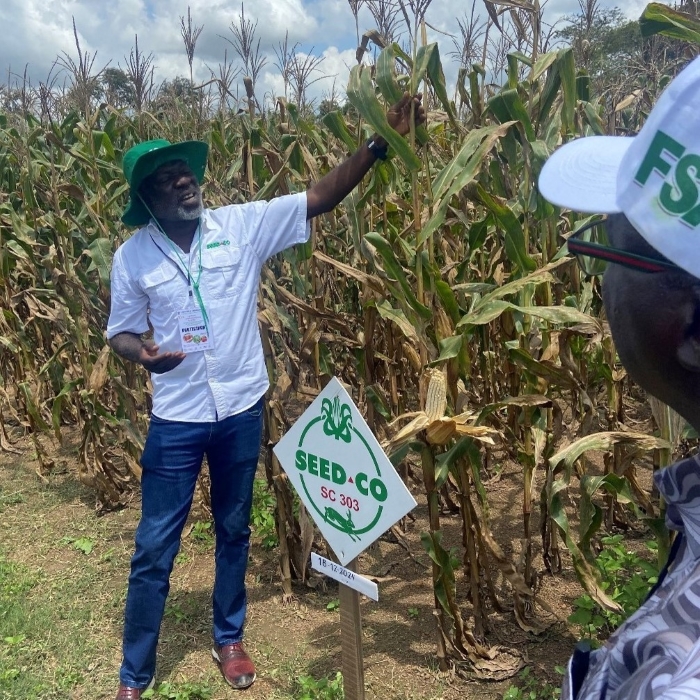
Photo above: Figure 2F from the article shows SeedCo Manager and Agronomist Nicholas providing details on the SC 303 variety of maize. Photo provided by the author. |
|
|
|
11th Annual Rich Earth Summit: Reclaiming Urine as a Resource
The Rich Earth Summit, hosted by Rich Earth Institute, is a virtual, global event dedicated to advancing urine reclamation to create sustainable and just nutrient cycles. |
|
|
This gathering brings together researchers, practitioners, and advocates to share knowledge and foster collaboration. Join us at the 11th annual Summit on November 12-14, 2025 — a golden opportunity to explore the transformative power of peecycling. Together, we can pee the change! Learn more and register HERE |
|
|
JAFSCD SHAREHOLDER WEBINAR |
|
|
Join Dalhousie University and CIHEAM Montpellier for Growing Agency, the 6th webinar in the Sustainable Diets series, on Thurs., November 20, 9-10am EST. Learn about food sovereignty movements around the world and discuss strategies for communities to reclaim power over food systems. Register for free HERE |
|
|
SUPPORT JAFSCD THROUGH YOUR LIBRARY! |
|
|
| If you are affiliated with a college or university and want to support JAFSCD, now is the time of year when libraries order new journal subscriptions. |
|
|
How do I know if my library already contributes? Check the list here (scroll down on the page).
Isn't JAFSCD open access and free? It is! But we are a community-supported journal. Libraries contribute to become JAFSCD Library Shareholders instead of buying a subscription — keeping JAFSCD free to all instead of buying access just for their faculty and students. Think of us as the CSA of journals!
Considering submitting a manuscript to JAFSCD? If your institution is a JAFSCD Shareholder, you benefit by having our US$750 APC waived automatically.
How do I recommend JAFSCD to my library? Tell your librarian why JAFSCD is important to your work, and send them this link to learn more!
Contact Amy Christian, managing editor, for details or assistance. |
|
|
This email is sent to you as a notification of the newest JAFSCD articles and other occasional JAFSCD news. |
|
JAFSCD is an open access, community-supported journal! Your library, program, or organization can become a shareholder to help keep JAFSCD's content available to all, regardless of their resources. We welcome anyone to become an individual shareholder; donations are tax-deductible to the extent allowed by law.
|
|
|
|