JAFSCD peer-reviewed article by Catherine Brinkley, Benjamin Chrisinger, and Amy Hillier (all at U of Pennsylvania)
Over recent years, a broad literature has documented and described the nature of urban health disparities, including racial, ethnic, and income disparities in access to healthful foods. Researchers have quantified negative health outcomes associated with poor access to healthy foods, including high instances of obesity and other diet-related disease. Motivated by these findings, a broad range of stakeholders have proposed and implemented numerous responses, including financing for food retailers in underserved areas (e.g., the federal Healthy Food Financing Initiative, Pennsylvania’s Fresh Food Financing Initiative, and California’s FreshWorks Fund); incentives for existing convenience and corner store retailers to stock more healthful foods; and “pop-up” food retail, such as mobile produce trucks and farmers’ markets.
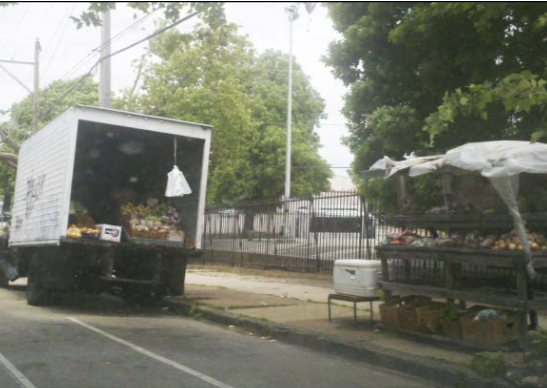
This article, Tradition of healthy food in low-income neighborhoods: Price and variety of curbside produce vending compared to conventional retailers, aimed to (1) describe curbside produce vendors and how they operate in West Philadelphia, and the policies and fees that regulate these small businesses; (2) analyze their location relative to demographic patterns, health outcomes, and other food outlets; and (3) compare the prices and varieties of whole fresh fruits and vegetables between curbside produce vendors and conventional outlets, including full-service supermarkets, limited-assortment grocery stores, and produce stores. The authors conclude with recommendations regarding zoning, licensing, and Supplemental Nutrition Assistant Program (SNAP) authorization that would help stabilize and expand this long-standing and popular model.
KEY FINDINGS
-
Curbside produce vendors listed land use regulations and SNAP accessibility as challenges to their business model. Despite the many steps and fees involved in city permitting, none of the vendors who were interviewed identified the permitting process as an impediment to their operations.
Vendors without landline telephone access were chiefly concerned with wireless SNAP/EBT access and transaction fees. Past research in the same neighborhood has found that providing farmers market vendors with individual wireless point-of-sale (POS) terminals and subsidizing EBT fees increased SNAP/EBT purchases by 38%.
Many vendors emphasized that their relationships with sellers at the Philadelphia Wholesale Produce Market (PWPM) are key to obtaining low-cost produce.
The informal relationships between vendors and neighborhood consumers through informal credit lines may also positively influence customer reliability and loyalty.
RECOMMENDATIONS FOR POLICY, PRACTICE, AND RESEARCH
In deepening the potential implications of this model, the authors propose to assess shopping habits and health differentials in the customer base for conventional markets and curbside produce markets. There is already extensive literature that supports the notion that store type can influence shopping habits and subsequent health outcomes in customers. If curbside produce vending is found to increase produce purchases or correlate with lower diet-related disease risk, it would merit policies to fast-track adoption of this model.
- Supply vendors with wireless SNAP/EBT access and subsidize transaction fees. The ability to redeem food assistance benefits is a critical factor for many customers; lowering barriers to EBT access will support both vendors and their customer base.
-
Review land use controls and ensure protection for curbside produce vendors. Clearly delineated areas where produce vending can occur as-of-right give greater legitimacy to vendors and may decrease the risk of nuisance complaints.
-
Conduct outreach to support truck maintenance, insulation or cooling, and facilitate inspection on-site. High capital costs may prevent vendors from upgrading or adequately maintaining their vital equipment, and knowledge of new funding sources and grants, like those made available to the Food Hub truck, could benefit many vendors.
SHARE ON YOUR SOCIALS
Curbside produce trucks emerged as an immigrant-run, long-standing business model in a low-income area of Philadelphia with poor health outcomes, and they offered lower cost fruits and vegetables when compared to supermarket outlets. Critical success factors for produce truck vendors are supportive city land use codes that allow curbside vending, a central wholesale produce market, and a network of personal relations with vendors, suppliers, and consumers. #foodaccess #produce #intervention Check out this @JAFSCD From the Vault article for free: https://doi.org/10.5304/jafscd.2013.041.011