from the Journal of Agriculture, Food Systems, and Community Development |
|
|
JAFSCD is the world’s only community-supported journal. JAFSCD content is open access (free) thanks to the generous support of our shareholders: the JAFSCD Shareholder Consortium, Library Shareholders, a growing number of Individual Shareholders, and our six JAFSCD Partners: |
|
|
Next-generation farmers face immense challenges in securing land. In recent years, some state- and federal-level land access policy incentives (LAPIs) have been implemented to address these challenges. One example is the Transition Incentives Program (TIP), an initiative of the U.S. Department of Agriculture’s Conservation Reserve Program (CRP) and funded by federal farm bills. TIP offers landowners who have farmland expiring from CRP two years of financial incentives for leasing or selling to a beginning or socially disadvantaged farmer or rancher (categories of farmers defined by the USDA).
In “An evaluation of the federal Transition Incentives Program on land access for next-generation farmers,” Megan Horst (corresponding author), Julia Valliant, and Julia Freedgood reflect on the program, using participation data and interviews with key stakeholders. As a component of the Land Access Policy Incentives project—a partnership between American Farmland Trust, Indiana University, and Portland State University—the authors aimed to understand how the program has, or has not, helped beginning and socially disadvantaged farmers. In doing so, they fill a crucial gap. No systematic research has explored CRP-TIP’s effectiveness since the program was created in the 2008 farm bill.
KEY POINTS
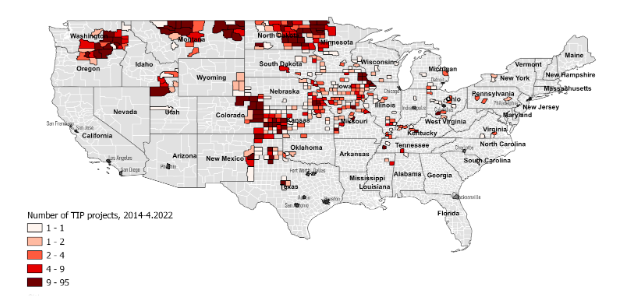
The authors found mixed results. Overall, participation is low. Between January 2014 and April 2022, there were roughly 2,700 CRP-TIP contracts, or an average of 300 per year. Participation varied across the country, but most of the contracts occurred in Mountain West, Midwest, and Plains states. Montana, Minnesota, North Dakota, Kansas, and Iowa led the way. There were also a high number of contracts in the Texas panhandle. While there are some known benefits, there are many limitations to the program’s effectiveness. The authors demonstrate a mismatch between where next-generation farmers live and high rates of TIP participation. Notably, there is little to no TIP participation in counties with higher-than-average rates of Black, Native American, and Latino farmers.
Variable participation may be due to inconsistent outreach and limits to the program design, which focus incentives on landowners and limits eligible land to land retiring from CRP.
TIP stands out among land access policy initiatives for trying to focus on beginning and socially disadvantaged farmers and ranchers. However, it seems that TIP only serves a subset of farmers and benefits mainly appear to accrue to landowners.
TIP alone is unlikely to have a significant impact on addressing the core land transition challenges faced by retiring farmers or the access challenges faced by next generation farmers.
The authors argue that on the whole, the program isn’t doing enough to address the mammoth problem of land access in American agriculture. The authors identify key barriers and provide ideas for reforming TIP to maximize participation. Ultimately, they call for much more structural interventions in land access and farming.
RECOMMENDATIONS FOR POLICY, PRACTICE, AND RESEARCH Some potential reforms to TIP that may expand participation and better serve next generation farmers include: - Refocus incentives to next-generation farmers and expand incentives to all farmland.
-
Allocate funds for underrepresented next-generation farmers, notably socially disadvantaged farmers and ranchers, to increase TIP participation.
- Expand targeted outreach and technical assistance to next-generation farmers.
-
Provide support to federal staff through timely program announcements, public outreach materials, education about systemic causes of inequities in farming and farmland access, best practice tips for outreach, and opportunities for state and local Farm Service Agency staff to exchange ideas.
- Engage landowners with expiring CRP contracts years before their contract expires.
While these reforms may enhance participation and better serve next generation farmers, a more holistic approach is needed to truly address land access barriers. SHARE ON YOUR SOCIALS
Has the federal Transition Incentives Program helped next-generation farmers access land? Does it serve underrepresented next-generation farmers and ranchers the most? The program has had mixed results, and reforms are needed. #farmlandaccess #beginningfarmers #farmersofcolor Read the full JAFSCD article for free: https://doi.org/10.5304/jafscd.2024.132.006
|
Image above: TIP participation varies across the country. Figure 4 in the article by Horst, Valliant, and Freedgood from the JAFSCD article. |
|
|
| In our News Flash of Feb. 15, we made an error in the link to John Ikerd's column in the current issue, "Perspectives on the past and future of agriculture."
Please read this thoughtful column for free at https://doi.org/10.5304/jafscd.2024.132.001 |
|
|
NEWS FROM OUR SISTER PROGRAM |
|
|
|
In this popular and free webinar series from our sister program NAFSN, panelists share connections and insights to help attendees identify possibilities for their careers. The spring 2024 series highlights job creators across the food systems profession.
There is still time to join us for the next Finding Your Future in Food Systems webinar with Delaney Gobster (Capstone Lecturer at the Nelson Institute for Environmental Studies), Kathia Ramirez (Policy Advocate at Pinelands Preservation Alliance), and Ben Rasmussen (Executive Director of the National Center for Frontier Communities).
TONIGHT, February 27, 6:00-7:00 pm ET
REGISTER for this free event! |
|
|
The Community & Agriculture Resilience Audit Tool — CARAT — helps community stakeholders assess how they currently use the assets of their local food system to achieve a substantial level of community resilience. CARAT measures the resources in a food system via 101 indicators to determine possible next steps to increase community resiliency and food sovereignty. CARAT is accepting applications for communities interested in piloting the program.
Access the CARAT Pilot application—due Feb. 29.
|
| |
|
This email is sent to you as a notification of the newest JAFSCD articles and other occasional JAFSCD news. |
|
JAFSCD is an open access, community-supported journal! Your library, program, or organization can become a shareholder to help keep JAFSCD's content available to all, regardless of their resources. We welcome anyone to become an individual shareholder; donations are tax-deductible to the extent allowed by law.
| |
|
|