from the Journal of Agriculture, Food Systems, and Community Development |
|
|
JAFSCD is the world’s only community-supported journal. JAFSCD content is open access (free) thanks to the generous support of our shareholders: the JAFSCD Shareholder Consortium, Library Shareholders, a growing number of Individual Shareholders, and our seven JAFSCD Partners: |
|
|
A newfound threat to Haitian health: Imported rice JAFSCD peer-reviewed article by Victoria Koski-Karell (U of Michigan), Rolinx Jean Monprevil (Community Organization for Haitian Agriculture), Justin Schell (U of Michigan), Natalie Sampson (U of Michigan-Dearborn), Simone Charles (U of Michigan), and Jaclyn Goodrich (U of Michigan) |
| |
|
Nearly a quarter of dietary intake in Haiti comes from rice, most of which is imported into the country from the U.S. Haitian farmers also cultivate and sell local rice, but they face a market flooded with cheaper foreign imports. Rice consumption can be a significant source of exposure to toxic metals since rice plants accumulate arsenic and cadmium from their environment. Ingesting high levels of arsenic and cadmium during early life or over the long term can increase the risk of various cancers, heart disease, diabetes, and other illnesses. The results of this study have important implications for policymakers, vendors, and consumers who seek to safeguard health in Haiti. Amid reports of gastrointestinal discomfort after eating foreign rice brands, investigators collaborated with an organization of rural Haitian farmers to compare the levels of arsenic and cadmium in imported versus locally grown rice. In a new JAFSCD article, "Exposure to the global rice trade: A comparative study of arsenic and cadmium in rice consumed in Haiti," authors Victoria Koski-Karell, Rolinx Jean Monprevil, Justin Schell, Natalie Sampson, Simone Charles, and Jaclyn Goodrich present findings from the first study of its kind to measure heavy metal levels in rice consumed in Haiti, where the rice market is dominated by foreign imports. KEY POINTS - Median concentrations were nearly two-fold higher for both arsenic and cadmium in imported rice compared to local rice.
- All samples of rice grown in Haiti were found to have arsenic levels below international limits recommended to protect human health from arsenic exposure. Some imported rice samples exceeded these levels.
- Adults of varying weights consuming 3 or more cups of imported rice per day would exceed a daily minimum risk level for toxicity. According to recent United Nations estimates, Haitians eat an average of 2.9 cups of rice per day.
- Most children consuming 1 or more cups of local or imported rice per day would exceed a health-based arsenic intake limit.
RECOMMENDATIONS FOR POLICY, PRACTICE, AND RESEARCH - Further research is necessary to assess arsenic levels present in the bodies of Haitian consumers and the likelihood of adverse health effects linked to chronic arsenic exposure.
- More research is needed to consider the ethical implications of conducting food safety studies in resource-limited settings that are already facing extreme food insecurity.
- Also worthy of ethical investigation are the rice corporations in the United States and elsewhere that are facilitating the export of food with elevated levels of arsenic to Haiti and other low- and middle-income countries.
- There is a pressing need to strengthen the efficacy of food safety regulations and interventions in Haiti, possibly at multiple levels of government. In Haiti, the Ministry of Commerce and Industry and the Ministry of Public Health and Population share responsibility for consumer safety and food safety, respectively, yet lack access to mass spectrometry instruments needed to quantify arsenic and cadmium levels in rice the population is consuming.
- The results of this study can help to equip Haitian consumers with knowledge to make informed purchases when possible and advocate for improved food safety.
- The government and citizens of Haiti need to do more to support Haitian rice farmers and the national agricultural sector so that Haitian consumers can have access to safe, locally grown food and a diverse, healthful diet. By maintaining a system dependent almost exclusively on U.S. rice, Haiti is importing a substantial amount of risk.
- For almost three decades, U.S. farm bill legislation has directed tax dollars toward making rice one of the most heavily supported commodities in the U.S. The overwhelming presence of foreign—and particularly U.S.-grown—rice in Haiti is grounded in a history of policy reforms intended to allow this heavily subsidized U.S. rice to flood Haiti’s market. A country of 11 million, Haiti is the second largest export market for U.S. rice. This system perpetuates poverty and hardship for Haitian rice farmers, as well as for millions of others in countries on the receiving end of cheaper foreign imports. With the 2023 farm bill soon up for discussion, there is an opportunity for legislators and their constituents to promote a more equitable system that ultimately benefits all.
SHARE ON YOUR SOCIALS Is imported rice harmful to Haitians? A new study finds nearly double the arsenic & cadmium levels in imported rice compared to locally grown rice. #Haiti #rice #publichealth #foodsystems #foodjustice #sustainableagriculture #arsenic #cadmium #toxicology Read it for free at @JAFSCD: https://doi.org/10.5304/jafscd.2024.132.002 |
Photo above: A billboard in Cap-Haitien for a backroad automobile rally reads “American rice is tasty and of good quality,” sponsored by USA Rice. Photo by Victoria Koski-Karell, 2019. |
|
|
NEWS FROM OUR SISTER PROGRAM |
|
|
NAFSN's new Community & Agriculture Resilience Audit Tool (CARAT) helps community stakeholders assess how the assets of their local food system have led to community resilience, and how they can build even greater resilience. At this meeting, the CARAT team will introduce CARAT and discuss the application process and structure for the CARAT Pilot 2024. When: Monday, February 12, 12:00-1:00 pm ET |
| |
|
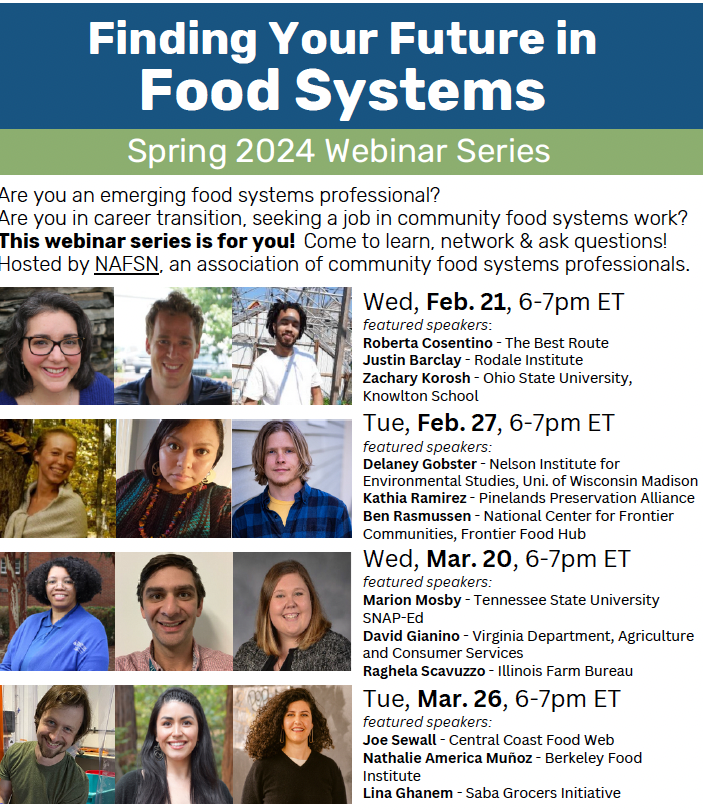
| In this popular and free webinar series, NAFSN shares connections and insights to help participants identify possibilities for their careers. The spring 2024 series highlights job creators across the food systems profession. Join us for the next Finding Your Future in Food Systems webinar with Roberta Cosentino, The Best Route; Justin Barclay, Rodale Institute; and Zachary Korosh, Ohio State U. When: Wed., February 21, 6:00-7:00 pm ET REGISTER for this free event |
|
|
This email is sent to you as a notification of the newest JAFSCD articles and other occasional JAFSCD news. |
| JAFSCD is an open access, community-supported journal! Your library, program, or organization can become a shareholder to help keep JAFSCD's content available to all, regardless of their resources. We welcome anyone to become an individual shareholder; donations are tax-deductible to the extent allowed by law. |
|
|
|